Atomic Habits
My Personal Takeaways →Atomic Habits: An Easy & Proven Way to Build Good Habits & Break Bad Ones
By James Clear
-
Changes that seem small and unimportant at first will compound into remarkable results if you’re willing to stick with them for years. We all deal with setbacks but in the long run, the quality of our lives often depends on the quality of our habits. With the same habits, you’ll end up with the same results. But with better habits, anything is possible.
-
The backbone of this book is my four-step model of habits—cue, craving, response, and reward—and the four laws of behavior change that evolve out of these steps.
-
The strategies I cover will be relevant to anyone looking for a step-by-step system for improvement, whether your goals center on health, money, productivity, relationships, or all of the above.
Section 1: The Fundamentals (Why Tiny Changes Make a Big Difference)
Chapter 1: The Surprising Power of Atomic Habits
-
“The whole principle came from the idea that if you broke down everything you could think of that goes into riding a bike, and then improve it by 1 percent, you will get a significant increase when you put them all together.”
-
Too often, we convince ourselves that massive success requires massive action. Whether it is losing weight, building a business, writing a book, winning a championship, or achieving any other goal, we put pressure on ourselves to make some earth-shattering improvement that everyone will talk about. Meanwhile, improving by 1 percent isn’t particularly notable—sometimes it isn’t even noticeable—but it can be far more meaningful, especially in the long run. The difference a tiny improvement can make over time is astounding. Here’s how the math works out: if you can get 1 percent better each day for one year, you’ll end up thirty-seven times better by the time you’re done. Conversely, if you get 1 percent worse each day for one year, you’ll decline nearly down to zero. What starts as a small win or a minor setback accumulates into something much more.
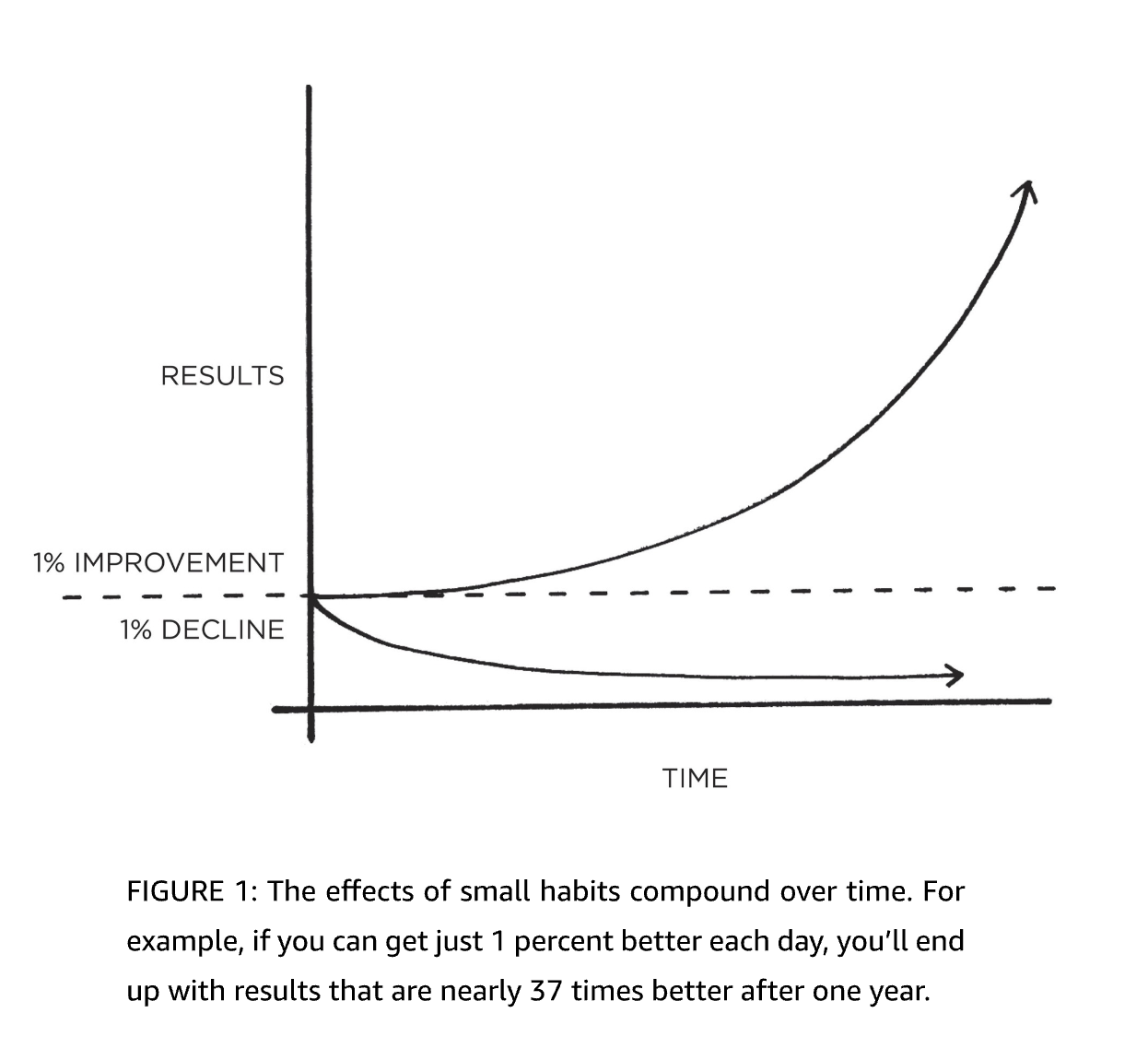
-
Habits are the compound interest of self-improvement. The same way that money multiplies through compound interest, the effects of your habits multiply as you repeat them. They seem to make little difference on any given day and yet the impact they deliver over the months and years can be enormous. It is only when looking back two, five, or perhaps ten years later that the value of good habits and the cost of bad ones becomes strikingly apparent.
-
If you save a little money now, you’re still not a millionaire. If you go to the gym three days in a row, you’re still out of shape. If you study Mandarin for an hour tonight, you still haven’t learned the language. We make a few changes, but the results never seem to come quickly and so we slide back into our previous routines. Unfortunately, the slow pace of transformation also makes it easy to let a bad habit slide. If you eat an unhealthy meal today, the scale doesn’t move much. If you work late tonight and ignore your family, they will forgive you. If you procrastinate and put your project off until tomorrow, there will usually be time to finish it later. A single decision is easy to dismiss. But when we repeat 1 percent errors, day after day, by replicating poor decisions, duplicating tiny mistakes, and rationalizing little excuses, our small choices compound into toxic results. It’s the accumulation of many missteps, a 1 percent decline here and there, that eventually leads to a problem.
-
The impact created by a change in your habits is similar to the effect of shifting the route of an airplane by just a few degrees. Imagine you are flying from Los Angeles to New York City. If a pilot leaving from LAX adjusts the heading just 3.5 degrees south, you will land in Washington, D.C., instead of New York. Such a small change is barely noticeable at takeoff—the nose of the airplane moves just a few feet -but when magnified across the entire United States, you end up hundreds of miles apart.
-
Success is the product of daily habits—not once-in-a-lifetime transformations.
-
That said, it doesn’t matter how successful or unsuccessful you are right now. What matters is whether your habits are putting you on the path toward success. You should be far more concerned with your current trajectory than with your current results.
-
Habits are a double-edged sword. Bad habits can cut you down just as easily as good habits can build you up, which is why understanding the details is crucial. You need to know how habits work and how to design them to your liking, so you can avoid the dangerous half of the blade.
-
Productivity compounds: The effect of automating an old task or mastering a new skill can be even greater. The more tasks you can handle without thinking, the more your brain is free to focus on other areas.
-
As Warren Buffett says, “That’s how knowledge works. It builds up, like compound interest.”
-
Relationships compound. People reflect your behavior back to you. The more you help others, the more others want to help you. Being a little bit nicer in each interaction can result in a network of broad and strong connections over time.
-
Stress compounds.
-
Negative thoughts compound.
-
Outrage compounds.
-
Imagine that you have an ice cube sitting on the table in front of you. The room is cold and you can see your breath. It is currently twenty-five degrees. Ever so slowly, the room begins to heat up. Twenty-six degrees. Twenty-seven. Twenty-eight. The ice cube is still sitting on the table in front of you. Twenty-nine degrees. Thirty. Thirty-one. Still, nothing has happened. Then, thirty-two degrees. The ice begins to melt. A one-degree shift, seemingly no different from the temperature increases before it, has unlocked a huge change.
-
Cancer spends 80 percent of its life undetectable, then takes over the body in months. Bamboo can barely be seen for the first five years as it builds extensive root systems underground before exploding ninety feet into the air within six weeks. Similarly, habits often appear to make no difference until you cross a critical threshold and unlock a new level of performance.
-
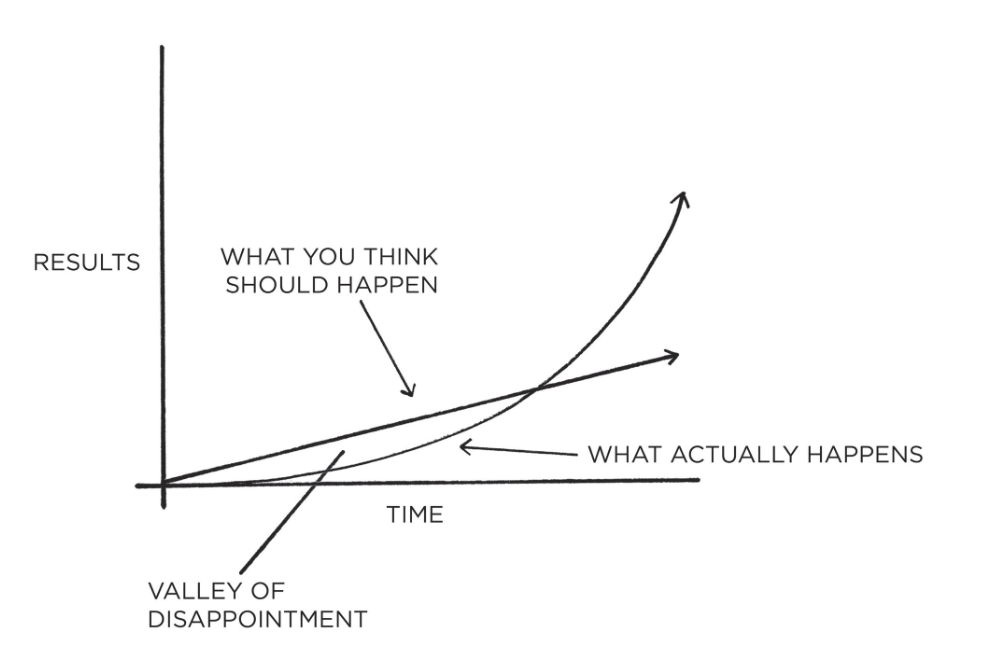
Complaining about not achieving success despite working hard is like complaining about an ice cube not melting when you heated it from twenty-five to thirty-one degrees. Your work was not wasted; it is just being stored. All the action happens at thirty-two degrees. When you finally break through the Plateau of Latent Potential, people will call it an overnight success. The outside world only sees the most dramatic event rather than all that preceded it. But you know that it’s the work you did long ago—when it seemed that you weren’t making any progress—that makes the jump today possible.
-
Two tectonic plates can grind against one another for millions of years, the tension slowly building all the while. Then, one day, they rub each other once again, in the same fashion they have for ages, but this time the tension is too great. An earthquake erupts. Change can take years—before it happens all at once.
-
We often expect progress to be linear. At the very least, we hope it will come quickly. In reality, the results of our efforts are often delayed. It is not until months or years later that we realize the true value of the previous work we have done. This can result in a “valley of disappointment” where people feel discouraged after putting in weeks or months of hard work without experiencing any results. However, this work was not wasted. It was simply being stored. It is not until much later that the full value of previous efforts is revealed.
-
I set goals for the grades I wanted to get in school, for the weights I wanted to lift in the gym, for the profits I wanted to earn in business. I succeeded at a few, but I failed at a lot of them. Eventually, I began to realize that my results had very little to do with the goals I set and nearly everything to do with the systems I followed.
-
Goals are about the results you want to achieve. Systems are about the processes that lead to those results.
-
Now for the interesting question: If you completely ignored your goals and focused only on your system, would you still succeed? For example, if you were a basketball coach and you ignored your goal to win a championship and focused only on what your team does at practice each day, would you still get results? I think you would. The goal in any sport is to finish with the best score, but it would be ridiculous to spend the whole game staring at the scoreboard.
-
Of course not. Goals are good for setting a direction, but systems are best for making progress. A handful of problems arise when you spend too much time thinking about your goals and not enough time designing your systems.
-
Problem #1: Winners and losers have the same goals.
- Every Olympian wants to win a gold medal. Every candidate wants to get the job. And if successful and unsuccessful people share the same goals, then the goal cannot be what differentiates the winners from the losers. It wasn’t the goal of winning the Tour de France that propelled the British cyclists to the top of the sport. Presumably, they had wanted to win the race every year before—just like every other professional team. The goal had always been there. It was only when they implemented a system of continuous small improvements that they achieved a different outcome.
-
Problem #2: Achieving a goal is only a momentary change.
- Imagine you have a messy room and you set a goal to clean it. If you summon the energy to tidy up, then you will have a clean room—for now. But if you maintain the same sloppy, pack-rat habits that led to a messy room in the first place, soon you’ll be looking at a new pile of clutter and hoping for another burst of motivation. You’re left chasing the same outcome because you never changed the system behind it. You treated a symptom without addressing the cause.
-
Problem #3: Goals restrict your happiness.
-
The implicit assumption behind any goal is this: “Once I reach my goal, then I’ll be happy.” The problem with a goals-first mentality is that you’re continually putting happiness off until the next milestone.
-
Furthermore, goals create an “either-or” conflict: either you achieve your goal and are successful or you fail and you are a disappointment. You mentally box yourself into a narrow version of happiness.
-
-
Problem #4: Goals are at ods with long-term progress
- You do not rise to the level of your goals. You fall to the level of your systems.
Chapter 2: How Your Habits Shape Your Identity (and Vice Versa)
-
Changing our habits is challenging for two reasons: (1) we try to change the wrong thing and (2) we try to change our habits in the wrong way.
-
THREE LAYERS OF BEHAVIOR CHANGE
-
The first layer is changing your outcomes
-
The second layer is changing your process. This level is concerned with changing your habits and systems: implementing a new routine at the gym, decluttering your desk for for better workflow, developing a meditation practice.
-
The third and deepest layer is changing your identity. This level is concerned with changing your beliefs: your worldview, your self-image, your judgments about yourself and others. Most of the beliefs assumptions, and biases you hold are associated with this level.
-
-
Outcomes are about what you get. Processes are about what you do. Identity is about what you believe. When it comes to building habits that last—when it comes to building a system of 1 percent improvements—the problem is not that one level is “better” or “worse” than another. All levels of change are useful in their own way. The problem is the direction of change. Many people begin the process of changing their habits by focusing on what they want to achieve. This leads us to outcome-based habits. The alternative 1s to build identity-based habits. With this approach, we start by focusing on who we wish to become.
-
With outcome-based habits, the focus is on what you want to achieve. With identity-based habits, the focus is on who you wish to become.

-
Imagine two people resisting a cigarette. When offered a smoke, the first person says, “No thanks. I’m trying to quit.” It sounds like a reasonable response, but this person still believes they are a smoker who is trying to be something else. They are hoping their behavior will change while carrying around the same beliefs. The second person declines by saying, “No thanks. I’m not a smoker.”
-
Most people don’t even consider identity change when they set out to improve. They just think, “I want to be skinny (outcome) and if I stick to this diet, then I’ll be skinny (process).” They set goals and determine the actions they should take to achieve those goals without considering the beliefs that drive their actions. They never shift the way they look at themselves, and they don’t realize that their old identity can sabotage their new plans for change.
-
You may want more money, but if your identity is someone who consumes rather than creates, then you’ll continue to be pulled toward spending rather than earning. You may want better health, but if you continue to prioritize comfort over accomplishment, you’ll be drawn to relaxing rather than training. It’s hard to change your habits if you never change the underlying beliefs that led to your past behavior. You have a new goal and a new plan, but you haven’t changed who you are.
-
The ultimate form of intrinsic motivation is when a habit becomes part of your identity. It’s one thing to say I’m the type of person who wants this. It’s something very different to say I’m the type of person who is this.
-
The more pride you have in a particular aspect of your identity, the more motivated you will be to maintain the habits associated with it.
-
If you’re proud of how your hair looks, you’ll develop all sorts of habits to care for and maintain it. If you’re proud of the size of your biceps, you’ll make sure you never skip an upper-body workout. If you’re proud of the scarves you knit, you’ll be more likely to spend hours knitting each week.
-
True behavior change is identity change. You might start a habit because of motivation, but the only reason you’ll stick with one is that it becomes part of your identity.
-
The goal is not to read a book, the goal is to become a reader. The goal is not to run a marathon, the goal is to become a runner. The goal is not to learn an instrument, the goal is to become a musician.
-
What you do is an indication of the type of person you believe that you are—either consciously or non-consciously.
-
“I’m terrible with directions.” “I’m not a morning person.” “I’m bad at remembering people’s names.” “I’m always late.” “I’m not good with technology.” “I’m horrible at math.” … and a thousand other variations. When you have repeated a story to yourself for years, it is easy to slide into these mental grooves and accept them as a fact.
-
There is internal pressure to maintain your self-image and behave in a way that is consistent with your beliefs.
-
Progress requires unlearning. Becoming the best version of yourself requires you to continuously edit your beliefs, and to upgrade and expand your identity.
-
THE TWO-STEP PROCESS TO CHANGING YOUR IDENTITY
-
Every action you take is a vote for the type of person you wish to become. No single instance will transform your beliefs, but as the votes build up, so does the evidence of your new identity. This is one reason why meaningful change does not require radical change. Small habits can make a meaningful difference by providing evidence of a new identity.
-
It is a simple two-step process: Decide the type of person you want to be. Prove it to yourself with small wins.
-
-
Building better habits isn’t about littering your day with life hacks. It’s not about flossing one tooth each night or taking a cold shower each morning or wearing the same outfit each day. It’s not about achieving external measures of success like earning more money, losing weight, or reducing stress. Habits can help you achieve all of these things, but fundamentally they are not about having something. They are about becoming someone.
Chapter 3: How to Build Better Habits in 4 Simple Steps
-
Habits do not restrict freedom. They create it. In fact, the people who don’t have their habits handled are often the ones with the least amount of freedom. Without good financial habits, you will always be struggling for the next dollar. Without good health habits, you will always seem to be short on energy. Without good learning habits, you will always feel like you’re behind the curve. If you’re always being forced to make decisions about simple tasks—when should I work out, where do I go to write, when do I pay the bills—then you have less time for freedom. It’s only by making the fundamentals of life easier that you can create the mental space needed for free thinking and creativity.
-
The process of building a habit can be divided into four simple steps: cue, craving, response, and reward.
-
What you crave is not the habit itself but the change in state it delivers. You do not crave smoking a cigarette, you crave the feeling of relief it provides. You are not motivated by brushing your teeth but rather by the feeling of a clean mouth. You do not want to turn on the television, you want to be entertained. Every craving is linked to a desire to change your internal state.
-
Rewards are the end goal of every habit. The cue is about noticing the reward. The craving is about wanting the reward. The response is about obtaining the reward. We chase rewards because they serve two purposes: (1) they satisfy us and (2) they teach us.
-
If a behavior is insufficient in any of the four stages, it will not become a habit. Eliminate the cue and your habit will never start. Reduce the craving and you won’t experience enough motivation to act. Make the behavior difficult and you won’t be able to do it. And if the reward fails to satisfy your desire, then you’ll have no reason to do it again in the future.
-
How to Create a Good Habit The 1st law (Cue): Make it obvious. The 2nd law (Craving): Make it attractive. The 3rd law (Response): Make it easy. The 4th law (Reward): Make it satisfying.
-
How to Break a Bad Habit Inversion of the 1st law (Cue): Make it invisible. Inversion of the 2nd law (Craving): Make it unattractive. Inversion of the 3rd law (Response): Make it difficult. Inversion of the 4th law (Reward): Make it unsatisfying.
Section 2: The 1st Law (Make It Obvious)
Chapter 4: The Man Who Didn’t Look Right
-
Pointing-and-Calling is so effective because it raises the level of awareness from a nonconscious habit to a more conscious level. Because the train operators must use their eyes, hands, mouth, and ears, they are more likely to notice problems before something goes wrong. My wife does something similar. Whenever we are preparing to walk out the door for a trip, she verbally calls out the most essential items in her packing list. “I’ve got my keys. I’ve got my wallet. I’ve got my glasses. I’ve got my husband.”
-
If you want to cut back on your junk food habit but notice yourself grabbing another cookie, say out loud, “I’m about to eat this cookie, but I don’t need it. Eating it will cause me to gain weight and hurt my health.” Hearing your bad habits spoken aloud makes the consequences seem more real.
Chapter 5: The Best Way to Start a New Habit
-
91 percent of the third group exercised at least once per week—more than double the normal rate. The sentence they filled out is what researchers refer to as an implementation intention, which is a plan you make beforehand about when and where to act. That is, how you intend to implement a particular habit. The cues that can trigger a habit come in a wide range of forms—the feel of your phone buzzing in your pocket, the smell of chocolate chip cookies, the sound of ambulance sirens—but the two most common cues are time and location. Implementation intentions leverage both of these cues. Broadly speaking, the format for creating an implementation intention is: “When situation X arises, I will perform response Y.”
-
The punch line is clear: people who make a specific plan for when and where they will perform a new habit are more likely to follow through. Too many people try to change their habits without these basic details figured out. We tell ourselves, “I’m going to eat healthier” or “I’m going to write more,” but we never say when and where these habits are going to happen. We leave it up to chance and hope that we will “just remember to do it” or feel motivated at the right time.
-
Many people think they lack motivation when what they really lack is clarity.
-
The simple way to apply this strategy to your habits is to fill out this sentence: I will [BEHAVIOR] at [TIME] in [LOCATION]. Meditation. I will meditate for one minute at 7 a.m. in my kitchen. Studying. I will study Spanish for twenty minutes at 6 p.m. in my bedroom. Exercise. I will exercise for one hour at 5 p.m. in my local gym. Marriage. I will make my partner a cup of tea at 8 a.m. in the kitchen.
-
When your dreams are vague, it’s easy to rationalize little exceptions all day long and never get around to the specific things you need to do to succeed.
-
In fact, the tendency for one purchase to lead to another one has a name: the Diderot Effect. The Diderot Effect states that obtaining a new possession often creates a spiral of consumption that leads to additional purchases. You can spot this pattern everywhere. You buy a dress and have to get new shoes and earrings to match. You buy a couch and suddenly question the layout of your entire living room. You buy a toy for your child and soon find yourself purchasing all of the accessories that go with it. It’s a chain reaction of purchases. Many human behaviors follow this cycle. You often decide what to do next based on what you have just finished doing.
-
No behavior happens in isolation. Each action becomes a cue that triggers the next behavior. Why is this important? When it comes to building new habits, you can use the connectedness of behavior to your advantage. One of the best ways to build a new habit is to identify a current habit you already do each day and then stack your new behavior on top. This is called habit stacking. Habit stacking is a special form of an implementation intention. Rather than pairing your new habit with a particular time and location, you pair it with a current habit.
-
Meditation. After I pour my cup of coffee each morning, I will meditate for one minute. Exercise. After I take off my work shoes, I will immediately change into my workout clothes. Gratitude. After I sit down to dinner, I will say one thing I’m grateful for that happened today. Marriage. After I get into bed at night, I will give my partner a kiss.
-
Exercise. When I see a set of stairs, I will take them instead of using the elevator. Social skills. When I walk into a party, I will introduce myself to someone I don’t know yet. Finances. When I want to buy something over $100, I will wait twenty-four hours before purchasing. Healthy eating. When I serve myself a meal, I will always put veggies on my plate first. Minimalism. When I buy a new item, I will give something away. (“One in, one out.”) Mood. When the phone rings, I will take one deep breath and smile before answering. Forgetfulness. When I leave a public place, I will check the table and chairs to make sure I don’t leave anything behind.
-
Consider when you are most likely to be successful. Don’t ask yourself to do a habit when you’re likely to be occupied with something else.
-
One way to find the right trigger for your habit stack is by brainstorming a list of your current habits.
-
In the first column, write down the habits you do each day without fail. For example: Get out of bed. Take a shower. Brush your teeth. Get dressed. Brew a cup of coffee. Eat breakfast. Take the kids to school. Start the work day. Eat lunch. End the work day. Change out of work clothes. Sit down for dinner. Turn off the lights. Get into bed.
-
In the second column, write down all of the things that happen to you each day without fail. For example: The sun rises. You get a text message. The song you are listening to ends. The sun sets.
-
Armed with these two lists, you can begin searching for the best place to layer your new habit into your lifestyle. Habit stacking works best when the cue is highly specific and immediately actionable.
-
The 1st Law of Behavior Change is to make it obvious. Strategies like implementation intentions and habit stacking are among the most practical ways to create obvious cues for your habits and design a clear plan for when and where to take action.
Chapter 6: Motivation Is Overrated; Environment Often Matters More
-
Every habit is context dependent.
-
Behavior is a function of the Person in their Environment, or B = f (P,E).
-
You don’t have to be the victim of your environment. You can also be the architect of it.
-
It’s easy not to practice the guitar when it’s tucked away in the closet. It’s easy not to read a book when the bookshelf is in the corner of the guest room. It’s easy not to take your vitamins when they are out of sight in the pantry.
-
Eventually, I took my own advice and redesigned my environment. I bought a large display bowl and placed it in the middle of the kitchen counter. The next time I bought apples, that was where they went—out in the open where I could see them. Almost like magic, I began eating a few apples each day simply because they were obvious rather than out of sight.
-
If you want to remember to take your medication each night, put your pill bottle directly next to the faucet on the bathroom counter. If you want to practice guitar more frequently, place your guitar stand in the middle of the living room. If you want to remember to send more thank-you notes, keep a stack of stationery on your desk. If you want to drink more water, fill up a few water bottles each morning and place them in common locations around the house.
-
If you want to make a habit a big part of your life, make the cue a big part of your environment. The most persistent behaviors usually have multiple cues.
-
Be the designer of your world and not merely the consumer of it.
-
The power of context also reveals an important strategy: habits can be easier to change in a new environment. It helps to escape the subtle triggers and cues that nudge you toward your current habits. Go to a new place—a different coffee shop, a bench in the park, a corner of your room you seldom use—and create a new routine there.
-
Want to think more creatively? Move to a bigger room, a rooftop patio, or a building with expansive architecture. Take a break from the space where you do your daily work, which is also linked to your current thought patterns. Trying to eat healthier? It is likely that you shop on autopilot at your regular supermarket. Try a new grocery store. You may find it easier to avoid unhealthy food when your brain doesn’t automatically know where it is located in the store.
-
You can use your phone for all sorts of tasks, which makes it a powerful device. But when you can use your phone to do nearly anything, it becomes hard to associate it with one task. You want to be productive, but you’re also conditioned to browse social media, check email, and play video games whenever you open your phone. It’s a mishmash of cues.
-
Relaxation is easier when you are in a space designed for that purpose.
-
If you want behaviors that are stable and predictable, you need an environment that is stable and predictable.
Chapter 7: The Secret to Self-Control
-
If you’re overweight, a smoker, or an addict, you’ve been told your entire life that it is because you lack self-control—maybe even that you’re a bad person. The idea that a little bit of discipline would solve all our problems is deeply embedded in our culture. Recent research, however, shows something different. When scientists analyze people who appear to have tremendous self-control, it turns out those individuals aren’t all that different from those who are struggling. Instead, “disciplined” people are better at structuring their lives in a way that does not require heroic willpower and self-control. In other words, they spend less time in tempting situations. The people with the best self-control are typically the ones who need to use it the least. It’s easier to practice self-restraint when you don’t have to use it very often. So, yes, perseverance, grit, and willpower are essential to success, but the way to improve these qualities is not by wishing you were a more disciplined person, but by creating a more disciplined environment.
-
Bad habits are autocatalytic: the process feeds itself. They foster the feelings they try to numb. You feel bad, so you eat junk food. Because you eat junk food, you feel bad. Watching television makes you feel sluggish, so you watch more television because you don’t have the energy to do anything else. Worrying about your health makes you feel anxious, which causes you to smoke to ease your anxiety, which makes your health even worse and soon you’re feeling more anxious. It’s a downward spiral, a runaway train of bad habits.
-
In the short-run, you can choose to overpower temptation. In the long-run, we become a product of the environment that we live in. To put it bluntly, I have never seen someone consistently stick to positive habits in a negative environment.
-
If you can’t seem to get any work done, leave your phone in another room for a few hours. If you’re continually feeling like you’re not enough, stop following social media accounts that trigger jealousy and envy. If you’re wasting too much time watching television, move the TV out of the bedroom. If you’re spending too much money on electronics, quit reading reviews of the latest tech gear. If you’re playing too many video games, unplug the console and put it in a closet after each use.
-
Make the cues of your good habits obvious and the cues of your bad habits invisible.
-
You can download a printable version of this habits cheat sheet at: atomichabits.com/cheatsheet
Section 3: The 2nd Law (Make It Attractive)
Chapter 8: How to Make a Habit Irresistible
-
Dopamine is released not only when you experience pleasure, but also when you anticipate it. Gambling addicts have a dopamine spike right before they place a bet, not after they win. Cocaine addicts get a surge of dopamine when they see the powder, not after they take it. Whenever you predict that an opportunity will be rewarding, your levels of dopamine spike in anticipation. And whenever dopamine rises, so does your motivation to act.
-
As an adult, daydreaming about an upcoming vacation can be more enjoyable than actually being on vacation. Scientists refer to this as the difference between “wanting” and “liking.”
-
Your brain has far more neural circuitry allocated for wanting rewards than for liking them. The wanting centers in the brain are large: the brain stem, the nucleus accumbens, the ventral tegmental area, the dorsal striatum, the amygdala, and portions of the prefrontal cortex. By comparison, the liking centers of the brain are much smaller.
-
Desire is the engine that drives behavior. Every action is taken because of the anticipation that precedes it. It is the craving that leads to the response.
-
Temptation bundling works by linking an action you want to do with an action you need to do.
-
The habit stacking + temptation bundling formula is: After [CURRENT HABIT], I will [HABIT I NEED]. After [HABIT I NEED], I will [HABIT I WANT].
-
After I get my morning coffee, I will say one thing I’m grateful for that happened yesterday (need). After I say one thing I’m grateful for, I will read the news (want).
-
After I pull out my phone, I will do ten burpees (need). After I do ten burpees, I will check Facebook (want).
-
Doing the thing you need to do means you get to do the thing you want to do.
Chapter 9: The Role of Family and Friends in Shaping Your Habits
-
Behaviors are attractive when they help us fit in. We imitate the habits of three groups in particular: The close. The many. The powerful.
-
We pick up habits from the people around us. We copy the way our parents handle arguments, the way our peers flirt with one another, the way our coworkers get results. When your friends smoke pot, you give it a try, too. When your wife has a habit of double-checking that the door is locked before going to bed, you pick it up as well.
-
One of the most effective things you can do to build better habits is to join a culture where your desired behavior is the normal behavior. New habits seem achievable when you see others doing them every day.
-
When you join a book club or a band or a cycling group, your identity becomes linked to those around you. Growth and change is no longer an individual pursuit. We are readers. We are musicians. We are cyclists.
-
When changing your habits means challenging the tribe, change is unattractive. When changing your habits means fitting in with the tribe, change is very attractive.
-
We are drawn to behaviors that earn us respect, approval, admiration, and status. We want to be the one in the gym who can do muscle-ups or the musician who can play the hardest chord progressions or the parent with the most accomplished children because these things separate us from the crowd. Once we fit in, we start looking for ways to stand out.
-
We are also motivated to avoid behaviors that would lower our status. We trim our hedges and mow our lawn because we don’t want to be the slob of the neighborhood. When our mother comes to visit, we clean up the house because we don’t want to be judged. We are continually wondering “What will others think of me?” and altering our behavior based on the answer.
Chapter 10: How to Find and Fix the Causes of Your Bad Habits
-
Some of our underlying motives include: Conserve energy, Obtain food and water, Find love and reproduce, Connect and bond with others, Win social acceptance and approval, Reduce uncertainty, and Achieve status and prestige. A craving is just a specific manifestation of a deeper underlying motive. Your brain did not evolve with a desire to smoke cigarettes or to check Instagram or to play video games. At a deep level, you simply want to reduce uncertainty and relieve anxiety, to win social acceptance and approval, or to achieve status.
-
Here’s the powerful part: there are many different ways to address the same underlying motive. One person might learn to reduce stress by smoking a cigarette. Another person learns to ease their anxiety by going for a run. Your current habits are not necessarily the best way to solve the problems you face; they are just the methods you learned to use. Once you associate a solution with the problem you need to solve, you keep coming back to it.
-
Another way, our behavior is heavily dependent on how we interpret the events that happen to us, not necessarily the objective reality of the events themselves.
-
Even the tiniest action is tinged with the motivation to feel differently than you do in the moment. When you binge-eat or light up or browse social media, what you really want is not a potato chip or a cigarette or a bunch of likes. What you really want is to feel different.
-
Sometimes, all you need is a slight mind-set shift. For instance, we often talk about everything we have to do in a given day. You have to wake up early for work. You have to make another sales call for your business. You have to cook dinner for your family. Now, imagine changing just one word: You don’t “have” to. You “get” to. You get to wake up early for work. You get to make another sales call for your business. You get to cook dinner for your family. By simply changing one word, you shift the way you view each event.
-
The key point is that both versions of reality are true. You have to do those things, and you also get to do them. We can find evidence for whatever mind-set we choose.
-
Exercise. Many people associate exercise with being a challenging task that drains energy and wears you down. You can just as easily view it as a way to develop skills and build you up. Instead of telling yourself “I need to go run in the morning,” say “It’s time to build endurance and get fast.” Finance. Saving money is often associated with sacrifice. However, you can associate it with freedom rather than limitation if you realize one simple truth: living below your current means increases your future means. The money you save this month increases your purchasing power next month.
-
Pregame jitters. Many people feel anxious before delivering a big presentation or competing in an important event. They experience quicker breathing, a faster heart rate, heightened arousal. If we interpret these feelings negatively, then we feel threatened and tense up. If we interpret these feelings positively, then we can respond with fluidity and grace. You can reframe “I am nervous” to “I am excited and I’m getting an adrenaline rush to help me concentrate.”
-
For instance, if you always play the same song before having sex, then you’ll begin to link the music with the act. Whenever you want to get in the mood, just press play.
Section 4: The 3rd Law (Make It Easy)
Chapter 11: Walk Slowly, but Never Backward
-
I refer to this as the difference between being in motion and taking action. The two ideas sound similar, but they’re not the same. When you’re in motion, you’re planning and strategizing and learning. Those are all good things, but they don’t produce a result. Action, on the other hand, is the type of behavior that will deliver an outcome. If I outline twenty ideas for articles I want to write, that’s motion. If I actually sit down and write an article, that’s action. If I search for a better diet plan and read a few books on the topic, that’s motion. If I actually eat a healthy meal, that’s action. Sometimes motion is useful, but it will never produce an outcome by itself. It doesn’t matter how many times you go talk to the personal trainer, that motion will never get you in shape. Only the action of working out will get the result you’re looking to achieve.
-
If motion doesn’t lead to results, why do we do it? Sometimes we do it because we actually need to plan or learn more. But more often than not, we do it because motion allows us to feel like we’re making progress without running the risk of failure. Most of us are experts at avoiding criticism. It doesn’t feel good to fail or to be judged publicly, so we tend to avoid situations where that might happen. And that’s the biggest reason why you slip into motion rather than taking action: you want to delay failure.
-
When preparation becomes a form of procrastination, you need to change something. You don’t want to merely be planning. You want to be practicing. If you want to master a habit, the key is to start with repetition, not perfection. You don’t need to map out every feature of a new habit. You just need to practice it. This is the first takeaway of the 3rd Law: you just need to get your reps in.
-
This phenomenon is commonly known as Hebb’s Law: “Neurons that fire together wire together.” Repeating a habit leads to clear physical changes in the brain. In musicians, the cerebellum—critical for physical movements like plucking a guitar string or pulling a violin bow—is larger than it is in non-musicians. Mathematicians, meanwhile, have increased gray matter in the inferior parietal lobule, which plays a key role in computation and calculation. Its size is directly correlated with the amount of time spent in the field;
-
Both common sense and scientific evidence agree: repetition is a form of change. Each time you repeat an action, you are activating a particular neural circuit associated with that habit. This means that simply putting in your reps is one of the most critical steps you can take to encoding a new habit.
-
The amount of time you have been performing a habit is not as important as the number of times you have performed it.
Chapter 12: The Law of Least Effort
-
Conventional wisdom holds that motivation is the key to habit change. Maybe if you really wanted it, you’d actually do it. But the truth is, our real motivation is to be lazy and to do what is convenient. And despite what the latest productivity best seller will tell you, this is a smart strategy, not a dumb one. Energy is precious, and the brain is wired to conserve it whenever possible. It is human nature to follow the Law of Least Effort, which states that when deciding between two similar options, people will naturally gravitate toward the option that requires the least amount of work.
-
If you can make your good habits more convenient, you’ll be more likely to follow through on them.
-
The idea behind make it easy is not to only do easy things. The idea is to make it as easy as possible in the moment to do things that payoff in the long run.
-
Imagine you are holding a garden hose that is bent in the middle. Some water can flow through, but not very much. If you want to increase the rate at which water passes through the hose, you have two options. The first option is to crank up the valve and force more water out. The second option is to simply remove the bend in the hose and let water flow through naturally. Trying to pump up your motivation to stick with a hard habit is like trying to force water through a bent hose. You can do it, but it requires a lot of effort and increases the tension in your life. Meanwhile, making your habits simple and easy is like removing the bend in the hose. Rather than trying to overcome the friction in your life, you reduce it.
-
I like to refer to this strategy as addition by subtraction. The Japanese companies looked for every point of friction in the manufacturing process and eliminated it. As they subtracted wasted effort, they added customers and revenue. Similarly, when we remove the points of friction that sap our time and energy, we can achieve more with less effort. (This is one reason tidying up can feel so good: we are simultaneously moving forward and lightening the cognitive load our environment places on us.)
-
Much of the battle of building better habits comes down to finding ways to reduce the friction associated with our good habits and increase the friction associated with our bad ones.
-
Nuckols dialed in his cleaning habits by following a strategy he refers to as “resetting the room.” For instance, when he finishes watching television, he places the remote back on the TV stand, arranges the pillows on the couch, and folds the blanket. When he leaves his car, he throws any trash away. Whenever he takes a shower, he wipes down the toilet while the shower is warming up. (As he notes, the “perfect time to clean the toilet is right before you wash yourself in the shower anyway.”) The purpose of resetting each room is not simply to clean up after the last action, but to prepare for the next action.
-
Whenever you organize a space for its intended purpose, you are priming it to make the next action easy. For instance, my wife keeps a box of greeting cards that are presorted by occasion—birthday, sympathy, wedding, graduation, and more. Whenever necessary, she grabs an appropriate card and sends it off. She is incredibly good at remembering to send cards because she has reduced the friction of doing so.
-
There are many ways to prime your environment so it’s ready for immediate use. If you want to cook a healthy breakfast, place the skillet on the stove, set the cooking spray on the counter, and lay out any plates and utensils you’ll need the night before. When you wake up, making breakfast will be easy. Want to draw more? Put your pencils, pens, notebooks, and drawing tools on top of your desk, within easy reach. Want to exercise? Set out your workout clothes, shoes, gym bag, and water bottle ahead of time. Want to improve your diet? Chop up a ton of fruits and vegetables on weekends and pack them in containers, so you have easy access to healthy, ready-to-eat options during the week.
-
If you find yourself watching too much television, for example, then unplug it after each use. Only plug it back in if you can say out loud the name of the show you want to watch.
-
If that doesn’t do it, you can take it a step further. Unplug the television and take the batteries out of the remote after each use, so it takes an extra ten seconds to turn it back on.
-
If sticking your phone in another room doesn’t seem like enough, tell a friend or family member to hide it from you for a few hours. Ask a coworker to keep it at their desk in the morning and give it back to you at lunch. It is remarkable how little friction is required to prevent unwanted behavior.
Chapter 13: How to Stop Procrastinating by Using the Two-Minute Rule
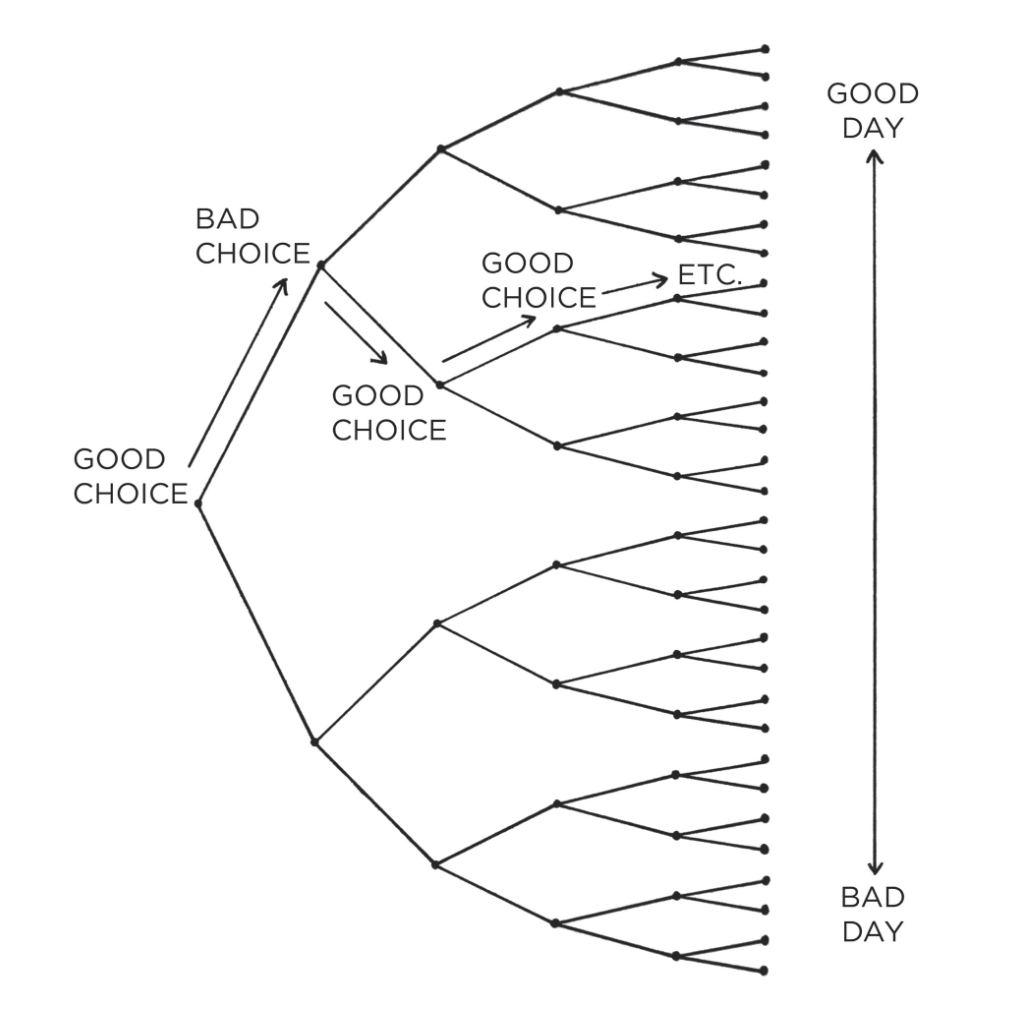
- Every day, there are a handful of moments that deliver an outsized impact. I refer to these little choices as decisive moments. The moment you decide between ordering takeout or cooking dinner. The moment you choose between driving your car or riding your bike. The moment you decide between starting your homework or grabbing the video game controller. These choices are a fork in the road.
-
The difference between a good day and a bad day is often a few productive and healthy choices made at decisive moments. Each one is like a fork in the road, and these choices stack up throughout the day and can ultimately lead to very different outcomes.
-
The most effective way I know to counteract this tendency is to use the Two-Minute Rule, which states, “When you start a new habit, it should take less than two minutes to do.” You’ll find that nearly any habit can be scaled down into a two-minute version: “Read before bed each night” becomes “Read one page.” “Do thirty minutes of yoga” becomes “Take out my yoga mat.” “Study for class” becomes “Open my notes.” “Fold the laundry” becomes “Fold one pair of socks.” “Run three miles” becomes “Tie my running shoes.”
-
What you want is a “gateway habit” that naturally leads you down a more productive path.
-
If you can’t learn the basic skill of showing up, then you have little hope of mastering the finer details. Instead of trying to engineer a perfect habit from the start, do the easy thing on a more consistent basis. You have to standardize before you can optimize. As you master the art of showing up, the first two minutes simply become a ritual at the beginning of a larger routine.
-
Journaling provides another example. Nearly everyone can benefit from getting their thoughts out of their head and onto paper, but most people give up after a few days or avoid it entirely because journaling feels like a chore. The secret is to always stay below the point where it feels like work. Greg McKeown, a leadership consultant from the United Kingdom, built a daily journaling habit by specifically writing less than he felt like. He always stopped journaling before it seemed like a hassle.
-
Becoming an Early Riser Phase 1: Be home by 10 p.m. every night. Phase 2: Have all devices (TV, phone, etc.) turned off by 10 p.m. every night. Phase 3: Be in bed by 10 p.m. every night (reading a book, talking with your partner). Phase 4: Lights off by 10 p.m. every night. Phase 5: Wake up at 6 a.m. every day.
Chapter 14: How to Make Good Habits Inevitable and Bad Habits Impossible
-
If you find yourself continually struggling to follow through on your plans, then you can take a page from Victor Hugo and make your bad habits more difficult by creating what psychologists call a commitment device. A commitment device is a choice you make in the present that controls your actions in the future. It is a way to lock in future behavior, bind you to good habits, and restrict you from bad ones.
-
I’ve even heard of athletes who have to “make weight” for a competition choosing to leave their wallets at home during the week before weigh-in so they won’t be tempted to buy fast food. As another example, my friend and fellow habits expert Nir Eyal purchased an outlet timer, which is an adapter that he plugged in between his internet router and the power outlet. At 10 p.m. each night, the outlet timer cuts off the power to the router. When the internet goes off, everyone knows it is time to go to bed.
-
Whenever I’m looking to cut calories, for example, I will ask the waiter to split my meal and box half of it to go before the meal is served. If I waited until the meal came out and told myself “I’ll just eat half,” it would never work.
-
If you’re feeling motivated to get in shape, schedule a yoga session and pay ahead of time.
-
One-Time Actions That Lock in Good Habits: Sleep: Buy a good mattress. Get blackout curtains. Remove your television from your bedroom. Productivity: Unsubscribe from emails. Turn off notifications and mute group chats. Set your phone to silent. Use email filters to clear up your inbox. Delete games and social media apps on your phone. Happiness: Get a dog. Move to a friendly, social neighborhood. General Health: Get vaccinated. Buy good shoes to avoid back pain. Buy a supportive chair or standing desk. Finance: Enroll in an automatic savings plan. Set up automatic bill pay. Cut cable service. Ask service providers to lower your bills.
-
The average person spends over two hours per day on social media. What could you do with an extra six hundred hours per year?) During the year I was writing this book, I experimented with a new time management strategy. Every Monday, my assistant would reset the passwords on all my social media accounts, which logged me out on each device. All week I worked without distraction. On Friday, she would send me the new passwords. I had the entire weekend to enjoy what social media had to offer until Monday morning when she would do it again. (If you don’t have an assistant, team up with a friend or family member and reset each other’s passwords each week.)
Section 5: The 4th Law (Make It Satisfying)
Chapter 15: The Cardinal Rule of Behavior Change
-
We are more likely to repeat a behavior when the experience is satisfying. This is entirely logical. Feelings of pleasure—even minor ones like washing your hands with soap that smells nice and lathers well—are signals that tell the brain: “This feels good. Do this again, next time.” Pleasure teaches your brain that a behavior is worth remembering and repeating.
-
Conversely, if an experience is not satisfying, we have little reason to repeat it. In my research, I came across the story of a woman who had a narcissistic relative who drove her nuts. In an attempt to spend less time with this egomaniac, she acted as dull and as boring as possible whenever he was around. Within a few encounters, he started avoiding her because he found her so uninteresting.
-
The first three laws of behavior change—make it obvious, make it attractive, and make it easy—increase the odds that a behavior will be performed this time. The fourth law of behavior change—make it satisfying—increases the odds that a behavior will be repeated next time. It completes the habit loop.
-
You live in what scientists call an immediate-return environment because your actions instantly deliver clear and immediate outcomes. Now switch back to your human self. In modern society, many of the choices you make today will not benefit you immediately. If you do a good job at work, you’ll get a paycheck in a few weeks. If you exercise today, perhaps you won’t be overweight next year. If you save money now, maybe you’ll have enough for retirement decades from now. You live in what scientists call a delayed-return environment because you can work for years before your actions deliver the intended payoff.
-
As the saying goes, the last mile is always the least crowded.
-
Thankfully, it’s possible to train yourself to delay gratification—but you need to work with the grain of human nature, not against it. The best way to do this is to add a little bit of immediate pleasure to the habits that pay off in the long-run and a little bit of immediate pain to ones that don’t.
-
You want to make avoidance visible. Open a savings account and label it for something you want—maybe “Leather Jacket.” Whenever you pass on a purchase, put the same amount of money in the account. Skip your morning latte? Transfer $5. Pass on another month of Netflix? Move $10 over. It’s like creating a loyalty program for yourself. The immediate reward of seeing yourself save money toward the leather jacket feels a lot better than being deprived. You are making it satisfying to do nothing. One of my readers and his wife used a similar setup. They wanted to stop eating out so much and start cooking together more. They labeled their savings account “Trip to Europe.” Whenever they skipped going out to eat, they transferred $50 into the account. At the end of the year, they put the money toward the vacation.
-
The more a habit becomes part of your life, the less you need outside encouragement to follow through. Incentives can start a habit. Identity sustains a habit. That said, it takes time for the evidence to accumulate and a new identity to emerge. Immediate reinforcement helps maintain motivation in the short term while you’re waiting for the long-term rewards to arrive.
Chapter 16: How to Stick with Good Habits Every Day
-
Dyrsmid began each morning with two jars on his desk. One was filled with 120 paper clips. The other was empty. As soon as he settled in each day, he would make a sales call. Immediately after, he would move one paper clip from the full jar to the empty jar and the process would begin again. “Every morning I would start with 120 paper clips in one jar and I would keep dialing the phone until I had moved them all to the second jar,” he told me.
-
Making progress is satisfying, and visual measures—like moving paper clips or hairpins or marbles—provide clear evidence of your progress. As a result, they reinforce your behavior and add a little bit of immediate satisfaction to any activity. Visual measurement comes in many forms: food journals, workout logs, loyalty punch cards, the progress bar on a software download, even the page numbers in a book. But perhaps the best way to measure your progress is with a habit tracker.
-
Countless people have tracked their habits, but perhaps the most famous was Benjamin Franklin. Beginning at age twenty, Franklin carried a small booklet everywhere he went and used it to track thirteen personal virtues. This list included goals like “Lose no time. Be always employed in something useful” and “Avoid trifling conversation.” At the end of each day, Franklin would open his booklet and record his progress.
-
Recording your last action creates a trigger that can initiate your next one. Habit tracking naturally builds a series of visual cues like the streak of X’s on your calendar or the list of meals in your food log. When you look at the calendar and see your streak, you’ll be reminded to act again.
-
One study of more than sixteen hundred people found that those who kept a daily food log lost twice as much weight as those who did not. The mere act of tracking a behavior can spark the urge to change it.
-
When the evidence is right in front of you, you’re less likely to lie to yourself.
-
Whenever possible, measurement should be automated.
-
No matter how consistent you are with your habits, it is inevitable that life will interrupt you at some point. Perfection is not possible. Before long, an emergency will pop up—you get sick or you have to travel for work or your family needs a little more of your time. Whenever this happens to me, I try to remind myself of a simple rule: never miss twice. If I miss one day, I try to get back into it as quickly as possible. Missing one workout happens, but I’m not going to miss two in a row. Maybe I’ll eat an entire pizza, but I’ll follow it up with a healthy meal.
-
The problem is not slipping up; the problem is thinking that if you can’t do something perfectly, then you shouldn’t do it at all.
-
As Charlie Munger says, “The first rule of compounding: Never interrupt it unnecessarily.” This is why the “bad” workouts are often the most important ones. Sluggish days and bad workouts maintain the compound gains you accrued from previous good days. Simply doing something—ten squats, five sprints, a push-up, anything really—is huge. Don’t put up a zero. Don’t let losses eat into your compounding. Furthermore, it’s not always about what happens during the workout. It’s about being the type of person who doesn’t miss workouts.
-
This pitfall is evident in many areas of life. We focus on working long hours instead of getting meaningful work done. We care more about getting ten thousand steps than we do about being healthy. We teach for standardized tests instead of emphasizing learning, curiosity, and critical thinking. In short, we optimize for what we measure. When we choose the wrong measurement, we get the wrong behavior.
-
This is why non-scale victories can be effective for weight loss. The number on the scale may be stubborn, so if you focus solely on that number, your motivation will sag. But you may notice that your skin looks better or you wake up earlier or your sex drive got a boost. All of these are valid ways to track your improvement. If you’re not feeling motivated by the number on the scale, perhaps it’s time to focus on a different measurement—one that gives you more signals of progress.
Chapter 17: How an Accountability Partner Can Change Everything
-
Throughout our discussion of the 4th Law of Behavior Change we have covered the importance of making good habits immediately satisfying. Fisher’s proposal is an inversion of the 4th Law: Make it immediately unsatisfying.
-
The more global, intangible, vague, and delayed the consequence, the less likely it is to influence individual behavior. Thankfully, there is a straightforward way to add an immediate cost to any bad habit: create a habit contract.
-
Finally, he wrote out each of the daily habits that would get him to his goal. For example, “Write down all food that he consumes each day and weigh himself each day.” And then he listed the punishment if he failed: “If Bryan doesn’t do these two items then the following consequence will be enforced: He will have to dress up each workday and each Sunday morning for the rest of the quarter. Dress up is defined as not wearing jeans, t-shirts, hoodies, or shorts. He will also give Joey (his trainer) $200 to use as he sees fit if he misses one day of logging food.” At the bottom of the page, Harris, his wife, and his trainer all signed the contract. My initial reaction was that a contract like this seemed overly formal and unnecessary, especially the signatures. But Harris convinced me that signing the contract was an indication of seriousness. “Anytime I skip this part,” he said, “I start slacking almost immediately.”
-
Suddenly, you are not only failing to uphold your promises to yourself, but also failing to uphold your promises to others.
-
You can even automate this process. Thomas Frank, an entrepreneur in Boulder, Colorado, wakes up at 5:55 each morning. And if he doesn’t, he has a tweet automatically scheduled that says, “It’s 6:10 and I’m not up because I’m lazy! Reply to this for $5 via PayPal (limit 5), assuming my alarm didn’t malfunction.”
Section 6: Advanced Tactics (How to Go from Being Merely Good to Being Truly Great)
Chapter 18: The Truth About Talent (When Genes Matter and When They Don’t)
-
In short: genes do not determine your destiny. They determine your areas of opportunity. As physician Gabor Mate notes, “Genes can predispose, but they don’t predetermine.” The areas where you are genetically predisposed to success are the areas where habits are more likely to be satisfying. The key is to direct your effort toward areas that both excite you and match your natural skills, to align your ambition with your ability. The obvious question is, “How do I figure out where the odds are in my favor? How do I identify the opportunities and habits that are right for me?” The first place we will look for an answer is by understanding your personality.
-
People who are talented in a particular area tend to be more competent at that task and are then praised for doing a good job. They stay energized because they are making progress where others have failed, and because they get rewarded with better pay and bigger opportunities, which not only makes them happier but also propels them to produce even higher-quality work. It’s a virtuous cycle.
-
The most common approach is trial and error. Of course, there’s a problem with this strategy: life is short. You don’t have time to try every career, date every eligible bachelor, or play every musical instrument. Thankfully, there is an effective way to manage this conundrum, and it is known as the explore/exploit trade-off. In the beginning of a new activity, there should be a period of exploration. In relationships, it’s called dating. In college, it’s called the liberal arts. In business, it’s called split testing. The goal is to try out many possibilities, research a broad range of ideas, and cast a wide net. After this initial period of exploration, shift your focus to the best solution you’ve found—but keep experimenting occasionally. The proper balance depends on whether you’re winning or losing. If you are currently winning, you exploit, exploit, exploit. If you are currently losing, you continue to explore, explore, explore.
-
Google famously asks employees to spend 80 percent of the workweek on their official job and 20 percent on projects of their choice, which has led to the creation of blockbuster products like AdWords and Gmail.
-
What feels like fun to me, but work to others? What makes me lose track of time? Where do I get greater returns than the average person? What comes naturally to me?
-
Scott Adams, the cartoonist behind Dilbert, says, “Everyone has at least a few areas in which they could be in the top 25% with some effort. In my case, I can draw better than most people, but I’m hardly an artist. And I’m not any funnier than the average standup comedian who never makes it big, but I’m funnier than most people. The magic is that few people can draw well and write jokes. It’s the combination of the two that makes what I do so rare. And when you add in my business background, suddenly I had a topic that few cartoonists could hope to understand without living it.” When you can’t win by being better, you can win by being different. By combining your skills, you reduce the level of competition, which makes it easier to stand out.
-
Specialization is a powerful way to overcome the “accident” of bad genetics. The more you master a specific skill, the harder it becomes for others to compete with you.
-
Boiling water will soften a potato but harden an egg. You can’t control whether you’re a potato or an egg, but you can decide to play a game where it’s better to be hard or soft. If you can find a more favorable environment, you can transform the situation from one where the odds are against you to one where they are in your favor.
-
Our genes do not eliminate the need for hard work. They clarify it. They tell us what to work hard on. Once we realize our strengths, we know where to spend our time and energy. We know which types of opportunities to look for and which types of challenges to avoid. The better we understand our nature, the better our strategy can be.
-
In summary, one of the best ways to ensure your habits remain satisfying over the long-run is to pick behaviors that align with your personality and skills. Work hard on the things that come easy.
Chapter 19: The Goldilocks Rule: How to Stay Motivated in Life and Work
-
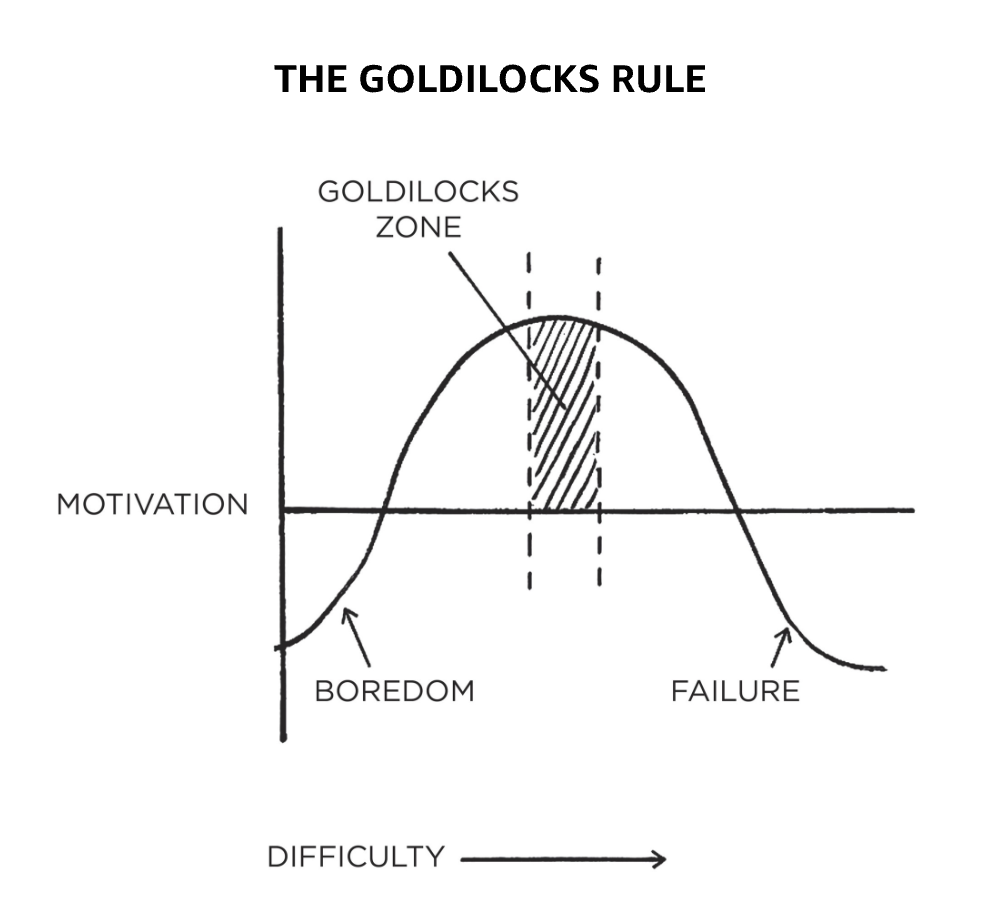
Why is it that some people, like Martin, stick with their habits—whether practicing jokes or drawing cartoons or playing guitar—while most of us struggle to stay motivated? How do we design habits that pull us in rather than ones that fade away? Scientists have been studying this question for many years. While there is still much to learn, one of the most consistent findings is that the way to maintain motivation and achieve peak levels of desire is to work on tasks of “just manageable difficulty.” The human brain loves a challenge, but only if it is within an optimal zone of difficulty. If you love tennis and try to play a serious match against a four-year-old, you will quickly become bored. It’s too easy. You’ll win every point. In contrast, if you play a professional tennis player like Roger Federer or Serena Williams, you will quickly lose motivation because the match is too difficult. Now consider playing tennis against someone who is your equal. As the game progresses, you win a few points and you lose a few. You have a good chance of winning, but only if you really try.
-
The Goldilocks Rule states that humans experience peak motivation when working on tasks that are right on the edge of their current abilities. Not too hard. Not too easy. Just right.
-
Maximum motivation occurs when facing a challenge of just manageable difficulty. In psychology research this is known as the Yerkes–Dodson law, which describes the optimal level of arousal as the midpoint between boredom and anxiety.
-
There were just enough victories to keep him motivated and just enough mistakes to keep him working hard. When you’re starting a new habit, it’s important to keep the behavior as easy as possible so you can stick with it even when conditions aren’t perfect. This is an idea we covered in detail while discussing the 3rd Law of Behavior Change. Once a habit has been established, however, it’s important to continue to advance in small ways. These little improvements and new challenges keep you engaged. And if you hit the Goldilocks Zone just right, you can achieve a flow state.
-
Improvement requires a delicate balance. You need to regularly search for challenges that push you to your edge while continuing to make enough progress to stay motivated. Behaviors need to remain novel in order for them to stay attractive and satisfying. Without variety, we get bored. And boredom is perhaps the greatest villain on the quest for self-improvement.
-
“At some point it comes down to who can handle the boredom of training every day, doing the same lifts over and over and over.”
-
Whether it’s business or sports or art, you hear people say things like, “It all comes down to passion.” Or, “You have to really want it.” As a result, many of us get depressed when we lose focus or motivation because we think that successful people have some bottomless reserve of passion. But this coach was saying that really successful people feel the same lack of motivation as everyone else. The difference is that they still find a way to show up despite the feelings of boredom.
-
The greatest threat to success is not failure but boredom. We get bored with habits because they stop delighting us. The outcome becomes expected. And as our habits become ordinary, we start derailing our progress to seek novelty. Perhaps this is why we get caught up in a never-ending cycle, jumping from one workout to the next, one diet to the next, one business idea to the next.
-
“Men desire novelty to such an extent that those who are doing well wish for a change as much as those who are doing badly.” Perhaps this is why many of the most habit-forming products are those that provide continuous forms of novelty. Video games provide visual novelty. Porn provides sexual novelty.
-
In psychology, this is known as a variable reward. Slot machines are the most common real-world example. A gambler hits the jackpot every now and then but not at any predictable interval. The pace of rewards varies. This variance leads to the greatest spike of dopamine, enhances memory recall, and accelerates habit formation. Variable rewards won’t create a craving—that is, you can’t take a reward people are uninterested in, give it to them at a variable interval, and hope it will change their mind—but they are a powerful way to amplify the cravings we already experience because they reduce boredom.
-
At some point, everyone faces the same challenge on the journey of self-improvement: you have to fall in love with boredom.
-
Professionals take action even when the mood isn’t right. They might not enjoy it, but they find a way to put the reps in.
Chapter 20: The Downside of Creating Good Habits
-
As a habit becomes automatic, you become less sensitive to feedback.
-
The upside of habits is that we can do things without thinking. The downside of habits is that you get used to doing things a certain way and stop paying attention to little errors.
-
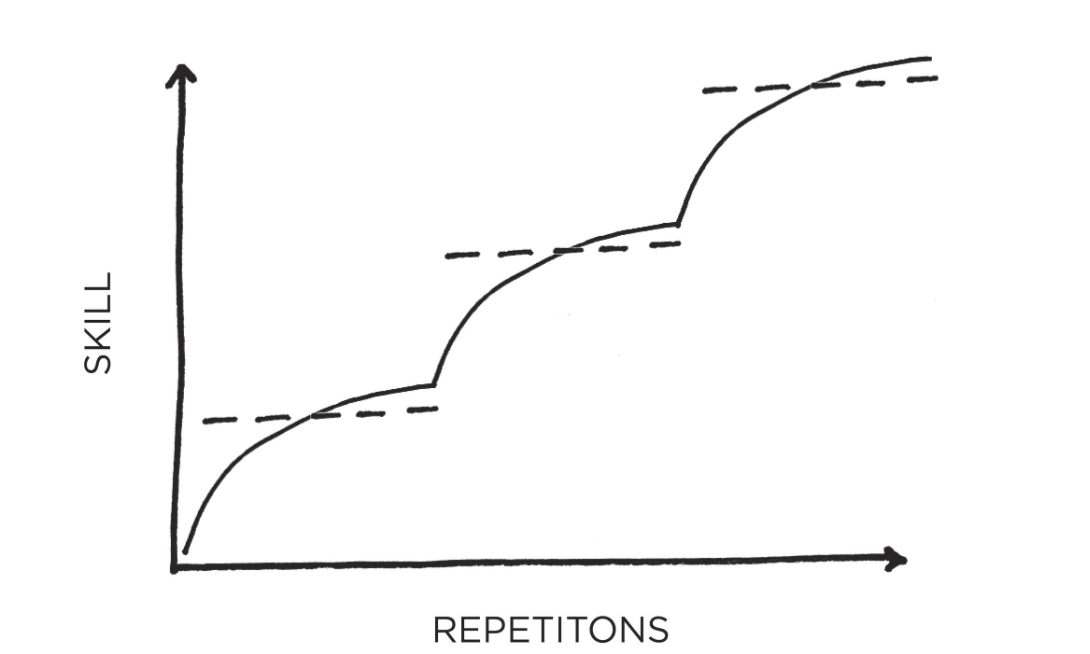
What you need is a combination of automatic habits and deliberate practice. Habits + Deliberate Practice = Mastery
-
The process of mastery requires that you progressively layer improvements on top of one another, each habit building upon the last until a new level of performance has been reached and a higher range of skills has been internalized.
-
The solution? Establish a system for reflection and review.
-
Personally, I employ two primary modes of reflection and review. Each December, I perform an Annual Review, in which I reflect on the previous year. I tally my habits for the year by counting up how many articles I published, how many workouts I put in, how many new places I visited, and more. Then, I reflect on my progress (or lack thereof) by answering three questions: What went well this year? What didn’t go so well this year? What did I learn? Six months later, when summer rolls around, I conduct an Integrity Report. Like everyone, I make a lot of mistakes. My Integrity Report helps me realize where I went wrong and motivates me to get back on course. I use it as a time to revisit my core values and consider whether I have been living in accordance with them. This is when I reflect on my identity and how I can work toward being the type of person I wish to become. My yearly Integrity Report answers three questions: What are the core values that drive my life and work? How am I living and working with integrity right now? How can I set a higher standard in the future? These two reports don’t take very long—just a few hours per year—but they are crucial periods of refinement. They prevent the gradual slide that happens when I don’t pay close attention. They provide an annual reminder to revisit my desired identity and consider how my habits are helping me become the type of person I wish to be.
-
Worrying too much about every daily choice is like looking at yourself in the mirror from an inch away. You can see every imperfection and lose sight of the bigger picture. There is too much feedback. Conversely, never reviewing your habits is like never looking in the mirror.
-
Periodic reflection and review is like viewing yourself in the mirror from a conversational distance. You can see the important changes you should make without losing sight of the bigger picture.
-
Finally, reflection and review offers an ideal time to revisit one of the most important aspects of behavior change: identity.
-
The key to mitigating these losses of identity is to redefine yourself such that you get to keep important aspects of your identity even if your particular role changes. “I’m an athlete” becomes “I’m the type of person who is mentally tough and loves a physical challenge.” “I’m a great soldier” transforms into “I’m the type of person who is disciplined, reliable, and great on a team.” “I’m the CEO” translates to “I’m the type of person who builds and creates things.”
-
Habits deliver numerous benefits, but the downside is that they can lock us into our previous patterns of thinking and acting—even when the world is shifting around us. Everything is impermanent. Life is constantly changing, so you need to periodically check in to see if your old habits and beliefs are still serving you. A lack of self-awareness is poison. Reflection and review is the antidote.
Conclusion: The Secret to Results That Last
-
There is an ancient Greek parable known as the Sorites Paradox, which talks about the effect one small action can have when repeated enough times. One formulation of the paradox goes as follows: Can one coin make a person rich? If you give a person a pile of ten coins, you wouldn’t claim that he or she is rich. But what if you add another? And another? And another? At some point, you will have to admit that no one can be rich unless one coin can make him or her so. We can say the same about atomic habits. Can one tiny change transform your life? It’s unlikely you would say so. But what if you made another? And another? And another? At some point, you will have to admit that your life was transformed by one small change. The holy grail of habit change is not a single 1 percent improvement, but a thousand of them. It’s a bunch of atomic habits stacking up, each one a fundamental unit of the overall system.
-
Each of the people, teams, and companies we have covered has faced different circumstances, but ultimately progressed in the same way: through a commitment to tiny, sustainable, unrelenting improvements. Success is not a goal to reach or a finish line to cross. It is a system to improve, an endless process to refine.
-
If you’re having trouble changing your habits, the problem isn’t you. The problem is your system.
-
Happiness is the state you enter when you no longer want to change your state. However, happiness is fleeting because a new desire always comes along. As Caed Budris says, “Happiness is the space between one desire being fulfilled and a new desire forming.”
-
With a big enough why you can overcome any how.
-
Being curious is better than being smart.
-
Emotions drive behavior.
-
Suffering drives progress.
-
Your actions reveal how badly you want something. If you keep saying something is a priority but you never act on it, then you don’t really want it.
-
Reward is on the other side of sacrifice.
-
Our expectations determine our satisfaction. The gap between our cravings and our rewards determines how satisfied we feel after taking action. If the mismatch between expectations and outcomes is positive (surprise and delight), then we are more likely to repeat a behavior in the future. If the mismatch is negative (disappointment and frustration), then we are less likely to do so. For example, if you expect to get $10 and get $100, you feel great. If you expect to get $100 and get $10, you feel disappointed.
-
“Being poor is not having too little, it is wanting more.”
-
Hope declines with experience and is replaced by acceptance. The first time an opportunity arises, there is hope of what could be. Your expectation (cravings) is based solely on promise. The second time around, your expectation is grounded in reality. You begin to understand how the process works and your hope is gradually traded for a more accurate prediction and acceptance of the likely outcome.
-
atomichabits.com/business
-
atomichabits.com/parenting