Tax-Free Wealth
My Personal Takeaways →Tax-Free Wealth: How to Build Massive Wealth by Permanently Lowering Your Taxes
By Tom Wheelwright
PART ONE: HOW THE TAX LAW CAN BE YOUR BEST FRIEND
CHAPTER ONE: TAXES ARE STEALING YOUR MONEY, YOUR TIME, AND YOUR FUTURE
-
People with lots of money have lots of time because they don’t have to spend their life trading their time for money. Instead, they can trade their money for time.
-
The average person in a developed country spends 25 to 35 percent of their life working to pay taxes. That means more than two hours of every workday are dedicated to feeding your government. And three to four months out of every year are spent working solely so that you can pay your taxes. That adds up to over 13 years in your work life and 20 years in your lifetime—20 years. That’s a prison sentence.
-
There are millions of people who legally pay little or no tax. What’s their secret? Do they know about loopholes that are in the law that allow them to get away with not paying tax? No. They simply understand how the tax law works. They understand that the tax law is not something the government uses only to raise taxes. The tax law is a tool the government uses to shape the economy and promote social, agricultural, and energy policy.
-
Include tax planning in your wealth strategy. Remember that it’s not just what you make that matters, it’s what you keep. When you keep taxes in mind as you invest, you end up keeping more money and make better investment decisions.
-
Just look at how much faster a $10,000 investment grows without taxes.

-
Your facts include your business activities, your investment activities, and your personal activities. They also include how you keep track of your activities. All taxes are based on your facts and circumstances. So if you want to change your tax, change your facts. It’s that simple.
-
Beware of Tax Preparers who: 1. Promise they can lower your taxes and who are really tax cheats. 2. Focus on postponing or “deferring” taxes to a later year. Real tax planning is permanent so you never have to repay the taxes.
-
Too many people ignore taxes when investing and planning their wealth strategy. They look at the return on investment as the return before they pay taxes on their investment income.
-
Regularly, I hear on the news that real estate is only a moderately successful investment on average. And if you were to compare it directly to some other investment before tax and without leverage (i.e., debt), you would have to agree. Let’s say you purchased a rental property for $500,000, with $100,000 of your own money and $400,000 of the bank’s money. Suppose that the annual return on your investment of $100,000 is 7%. Then, let’s suppose that you make a similar investment of $100,000 in the stock market that returns 10%. Which investment is a better return? It seems obvious that the stock market return of 10% is clearly better than the real estate return of 7%, right? Not so fast. The 10% return from the stock market will get you $10,000 before taxes. You will pay capital gains tax of about 20%, counting both federal and state taxes, leaving you with an after-tax return of $8,000. The 7% return on the real estate investment will get you a before-tax return of $7,000. Due to the magic of depreciation (chapter 7), you won’t pay any tax on your $7,000. Still, $7,000 is less than your after tax return of $8,000 in the stock market, so it seems you are still better off in the stock market. Only, your real estate investment doesn’t just give you tax-free cash flow. It actually reduces your taxes on your salary and/or business income, because while there is positive cash flow of $7,000, the depreciation deduction of about $27,000 gives you a tax deduction against your other income of $20,000 ($27,000 less $7,000 to offset real estate income). That $20,000 additional deduction against your other income is worth $6,000 of reduced taxes on your other income in a typical 30% ordinary income tax bracket. So your real return from your real estate is $7,000 plus an additional $6,000 of tax refund on taxes you normally would have paid on your salary and business income for a total return of $13,000, or $5,000 more than your after-tax return from the stock investment.
CHAPTER TWO: TAXES ARE FUN, EASY, AND UNDERSTANDABLE
-
The reality is that taxes can kill your hopes and dreams. How? By stealing your wealth and diminishing your quality of life. That surprise vacation for your family? Gone, thanks to Uncle Sam. The improvements you need to make to your house? Kiss them goodbye come tax time.
-
Worldwide, the average person pays 30 to 50 percent or more of their hard-earned income in taxes, either through income, sales, value-added, payroll, estate, or property taxes. Think about that. Almost a third to one-half of the world’s wealth is handed over to governments.
-
Invest where you travel. Do you have a favorite destination? Consider investing in the area. It gives you a great reason to keep returning, and you turn the travel expenses you already have into deductible expenses, keeping more money in your pocket.
-
Any travel can be deductible by making it a business or investment expense. As long as your travel has its primary purpose as business, then all of the travel expenses, including hotel, airfare and meals, will be deductible. In order for travel’s primary purpose to be business, the IRS says that you have to spend more time doing business than you do in recreation.
CHAPTER THREE: THE TWO MOST IMPORTANT RULES
-
Learn how your LLC (limited liability company) can be whatever it wants to be. The LLC has become the entity of choice for asset protection purposes. But what about tax purposes? Your LLC can be whatever it wants to be—a sole proprietorship, a partnership, a C Corporation, or an S Corporation. This flexibility gives you the best of the tax and asset protection worlds. In some countries without LLCs, the LLP (limited liability partnership) may give you similar flexibility.
-
Simply by understanding that LLCs can be treated any way you want for tax purposes, you have asset protection and still get the tax advantages of the S corporation, C corporation or partnership rules.
-
Suppose you are just starting a new business. You may want your entity to be treated as a sole proprietorship in the early years when there is a loss or not much income so you don’t have to file another tax return (corporations have to file a separate income tax return from their owners). When you’re ready to change to an S Corporation to reduce your employment taxes (see Chapter 11), you can check the box on the form and file the election with the IRS.
CHAPTER FOUR: PUT MONEY BACK IN YOUR POCKET — NOW
-
In many countries, including the United States, you can file amended returns anytime, which correct errors on returns for up to the previous three years if you learn that you paid too much in a prior year. Or you can even carry back a loss from the current year to a prior year, use the loss to offset the prior year’s income, and get a refund now.
-
Eat while you work and save taxes. Business meals are a great way to spend time with employees, clients, and customers. You can discuss business and turn your meal expense into a deductible expense.
-
But what if you could get a 20 to 30 percent discount on all of your purchases any time of the year? That’s exactly what happens when you change your expenses from a personal expense to a business deduction. The government essentially pays for 20 to 30 percent of your purchase in the form of a tax deduction.
-
First, the expense must have a business purpose, which means the primary reason for spending money was for your business. Take meals as an example. To be deductible, the purpose of a meal must be business. This means you need to have a conversation about business with your dining partner before, during, or after the meal. The other valid business meal would be if you were traveling away from home on business.
-
Second, the expense must be ordinary. An expense is ordinary if it is “customary and usual.” This means that within your industry, the expense should be typical of what would be spent, both in the amount of the expense and how often a person in your position would have the expense.
-
Third, the expense must be necessary. Necessary means that the purpose of the expense is to make more money for your business. It’s not enough just to go to lunch with someone and talk business simply because you are friends. Your conversation at lunch must have the intention of increasing the profits in your business.
-
These three rules are not difficult to meet. Let’s say, for example, that your business partner is your spouse. If you’re like most business partners, you’re always talking about business and always looking for ways to improve your business. So pretty much every opportunity you get to have a quiet meal together in a restaurant you will discuss business. Just don’t be extravagant about it on a regular basis. One rule of thumb here is that “pigs get fat and hogs get slaughtered.” If you are greedy and go out to expensive restaurants on a regular basis, the IRS may not look so kindly on your deductions for meals. Still, one of the most common mistakes I see is couples who are always talking about business when they go out to dinner but not paying for their meals with their business credit card.
CHAPTER FIVE: ENTREPRENEURS AND INVESTORS GET ALL THE BREAKS
-
The Cashflow Quadrant separates income earners into four quadrants. On the left side are the employees (E) and the self-employed individuals (S). On the right side are big business (B) and investors (I). When I first saw the diagram, my thoughts naturally went to the tax consequences (and benefits) of being in each of the quadrants. I quickly realized that those who earned their income from the left side of the quadrant pay much higher taxes than those who earn their income from the right side of the quadrant.
-
The reason why those on the B and I side of the quadrant pay so much less in tax than those on the E and S side has become clear to me. It’s because that’s what Congress or Parliament wanted.

-
So what does the government want? First, they want to create more jobs. Who creates jobs? Entrepreneurs. Therefore, entrepreneurs get all sorts of tax breaks that act as subsidies to encourage job creation. What else does the government want? Affordable housing. Real estate investors get all sorts of tax breaks that act as subsidies to encourage building of affordable housing. Sometimes governments make the mistake of thinking they can create jobs or build housing better than the free market. Eventually, they realize that the market does a better job. And it costs the government a lot less to give tax benefits to business owners and investors than it does to add jobs or build housing through government-sponsored programs.
-
Governments even get more specific about the types of investing and jobs they want the market to create by giving specific tax breaks for oil and gas investing, farming and other agriculture, green energy, and low-income housing.
-
Don’t Start a Business Just for the Tax Benefits:
- To get tax benefits, the business must be real and intend to make a profit.
- Paying taxes is less expensive than failing at business. Be sure to get educated before you begin.
-
Put your family to work. Make your business a family business. Then when you travel for business, your family’s travel is deductible. And you can shift income from your higher tax bracket to their lower tax bracket. This creates permanent tax savings.
-
The nice thing about having your children work for you is that you get a tax deduction at your higher tax bracket for the payroll and they report the income at their lower tax bracket.
-
My long-time friend and client did this with his 9-year-old daughter. He put her to work doing the bookkeeping for his real estate investments. She is a very intelligent 9-year old and has no problem understanding the bookkeeping. Her mother, who is in charge of their real estate, supervises her. She gets a reasonable wage for her work as compared to other bookkeepers. In a year, she might earn $4,000. That $4,000 will be a deduction to her parents. She doesn’t earn any other income and the standard deduction plus her exemptions is more than $4,000. So, she doesn’t pay any tax. In my client’s 40 percent tax bracket, that $4,000 in pay to their daughter means a tax savings of $1,600.
-
There are great tax benefits for you, huge educational benefits for them, and you have someone in place to take over when you are ready to retire. What an incredible exit strategy!
CHAPTER SIX: YOU CAN DEDUCT ALMOST ANYTHING
-
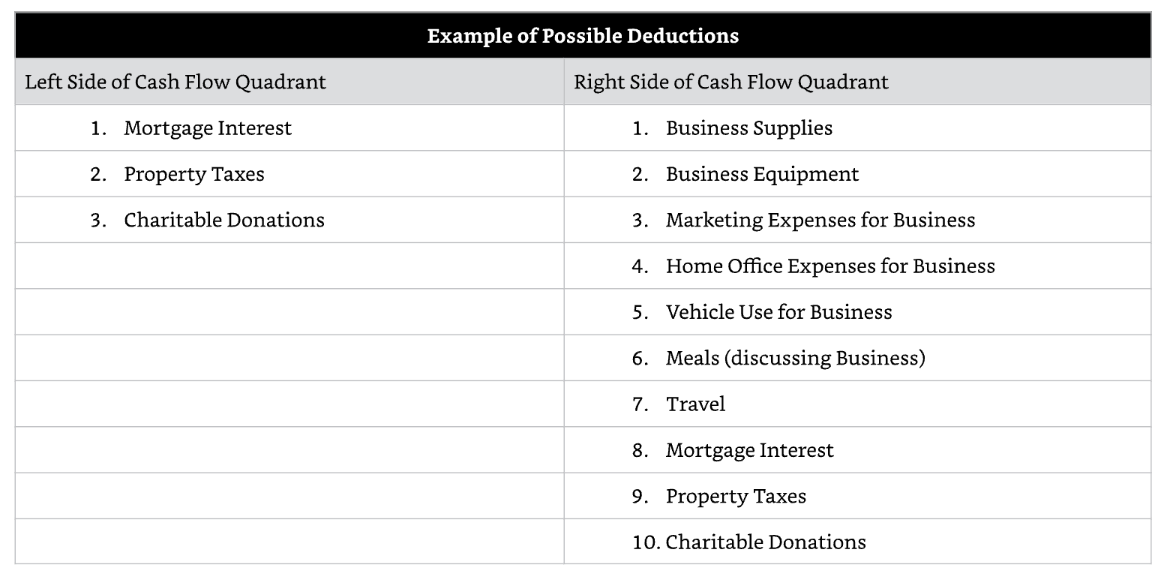
Business expenses are the best kind of deductions. Real estate expenses are the next best. Depending on your country, chances are that expenses relating to energy are good as well. Even expenses related to investing in the stock market may be partially deductible, though these are the least deductible because they aren’t active investments.
-
Your first step to increasing your deductible expenses is to become an entrepreneur or investor. Until you take this step, you’ll always be an average taxpayer and the tax laws will be stacked against you.
-
Remember that the right side of the Cashflow Quadrant includes both business owners and investors. But there’s one catch; you can’t be a typical investor if you’re going to enjoy the tax benefits of investing. You have to become an active investor. That means you have to be an investor who actively invests for passive income, not earned income. Very simply, passive income is income that comes from dividends, rents, and business. It’s taxed at a much lower rate than earned income, which comes from appreciation and capital gains, or from your paycheck. In order to become a super investor, you must find good, cash-flowing investments that produce passive income. A great book to read on this topic is the book Robert Kiyosaki and I wrote together, Why the Rich Are Getting Richer.
-
With the right tax strategy, they can even deduct losses from the investment against income they earn from other sources.
-
The key to good passive investing is a good team. You need a great investment advisor and a stellar tax advisor, as well as a good lawyer and a knowledgeable banker.
-
One of the best business or investment decisions you can make is to keep good documentation of your income and expenses.
-
The best way to enjoy deductible expenses is to start a business or to start investing for passive income. You don’t have to quit your job. Just start small. One of the best business and investing practices is to document your income and expenses, and to document them well.
CHAPTER SEVEN: DEPRECIATION: THE KIND OF ALL DEDUCTIONS
-
When you buy an asset that produces income, you can deduct a portion of it each year you own it. If it’s a physical asset, such as real estate or equipment, the deduction is called depreciation. If it’s an intangible asset (one you can’t feel or touch, such as a customer list or computer software), the deduction is called amortization. But in the end, the benefit is the same.
-
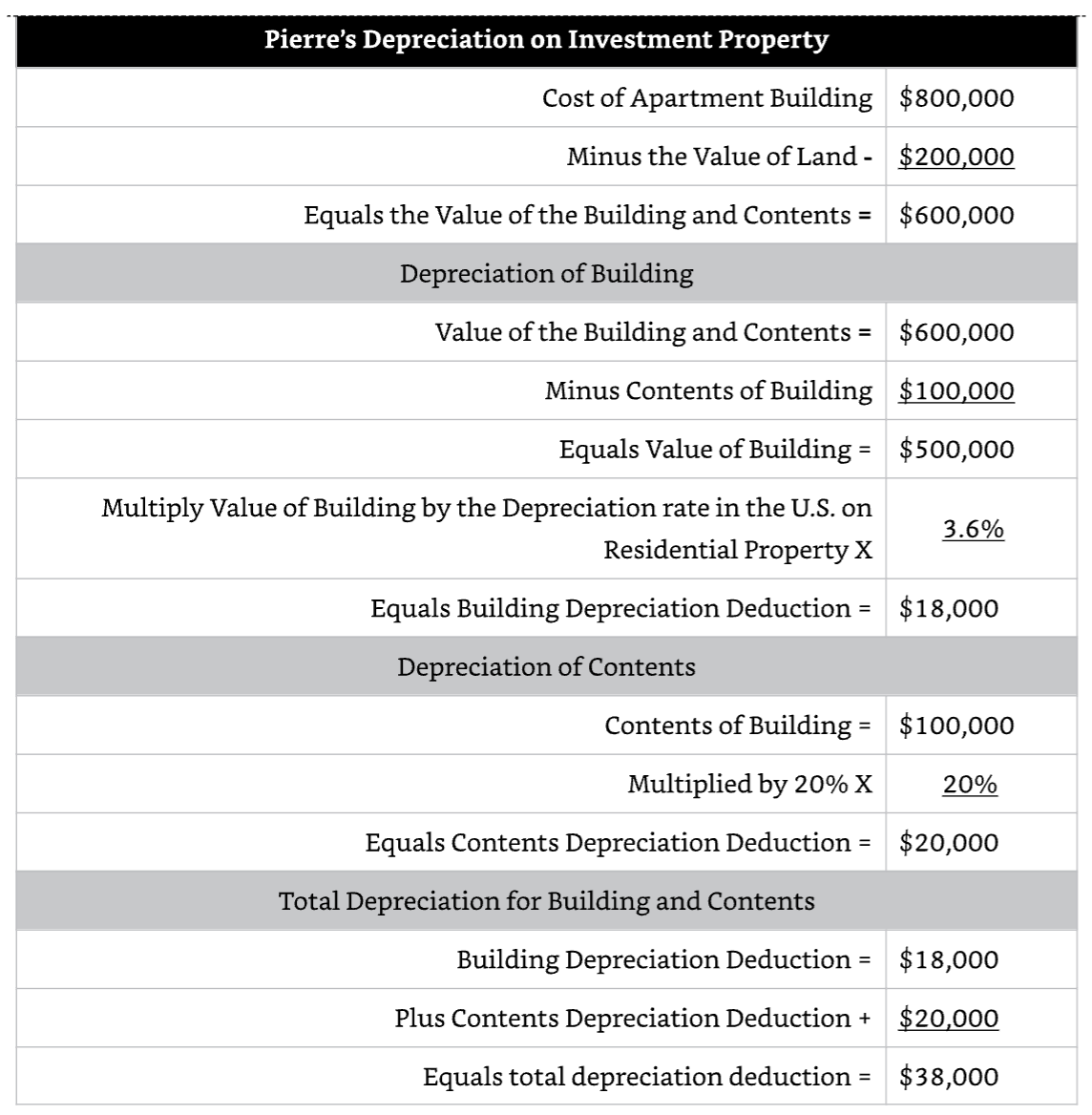
How much Pierre gets to deduct depends on how fast the government will let Pierre depreciate the building. In the United States, for instance, commercial buildings are currently depreciated over 39 years.
-
The actual building cost is a non-cash expense (an expense that doesn’t reduce your cash flow) that gives you a deduction. Even better, you not only get a deduction for the money you put into the building but you also get a deduction for the money the bank puts into the building. That’s right, you get a depreciation deduction for the entire cost of the building, even if you borrowed all the cash to pay for it from someone else.
-
He bought all of the floor coverings, the window coverings, the cabinetry, and more. So a portion of the $780,000 price tag for the building really applies to these other items. This is important because these other items can be depreciated faster than the building, putting more money into his pocket faster. One of the keys to taking full advantage of depreciation is to quickly get as much of your deduction as you can. The more deductions you can get today, the more money you can put in your pocket. And the more money you have in your pocket today, the more money you have to invest back into your business or into other investments.
-
In total, Pierre gets a deduction each year of about $37,500 [($680,000 ÷ 39 years) + ($100,000 × 20%)], which means that $37,500 of his restaurant income won’t be taxable. And this can pay off in a big way.
-
The trick is to properly document the values of all the items you depreciate in a cost segregation or chattel appraisal—even better, have a tax professional or engineer document them for you.
-
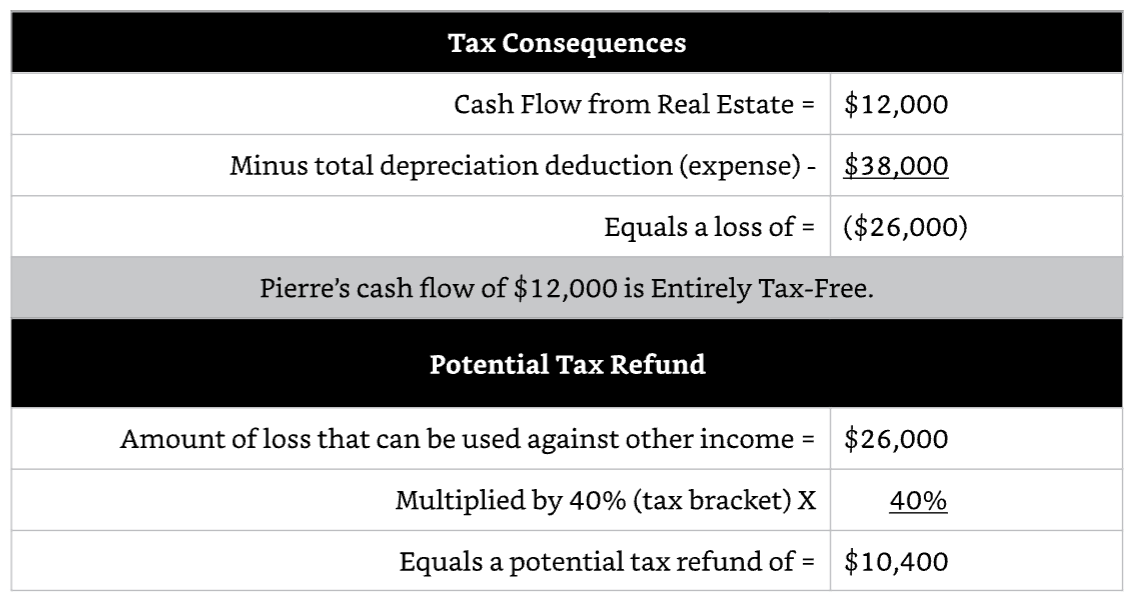
The tax benefits of long-term real estate investing can be equal to or even greater than the cash flow and increase in value (appreciation) from your properties.
-
Remember Your Tax Return Elections: 1. You must elect to deduct amortization. 2. Some amortization elections have to be clearly stated on your tax return in the year you first start using your intangible property.
-
Not only are cost segregations legal but they are specifically sanctioned by the IRS and technically required by law.
-
When you do a cost segregation on a building you have owned for several years, you must file a form 3115, “Change in Accounting Method.”
CHAPTER EIGHT: EARN BETTER INCOME
- Let’s use the example of my friend Pierre again. Remember, he’s the one who owns the restaurant, Chez Pierre. Suppose he earns $200,000 after his normal expenses through his restaurant this year. If he took all of that money out of the business, it would be taxed at regular rates. He doesn’t want to do that. So instead, let’s say he puts $80,000 back into the business in the form of additional supplies and equipment that will make even more income for him in the future and then puts another $20,000 into marketing. All of the money Pierre puts back into his business is deductible against his $200,000 of income. That would leave him with $100,000.
-
Modify your investment strategy. Some real estate investments have “built in” tax savings that don’t require you to do anything extra to write off the losses against any other income you have. Oil and gas are examples of these investments, where as much as 100 percent of the investment can be written off in the first year.
-
Think about your income as if you had to put it into one of five buckets.
-
The first bucket is your earned income. This bucket has some serious holes in it. Your income runs out of those holes in the form of high income taxes and high employment taxes. Even if you’re in a country where your employer pays the employment taxes, think about how much higher your income could be if your employer didn’t have to pay those taxes.
-
The second bucket is your ordinary income. This is income from your pension plan, your 401(k) plan, your registered retirement savings plan (RRSP), or Pension and certain other income that don’t fit into one of the other buckets. While this bucket is better than the earned income bucket, it’s still taxed at the highest income tax rates, but at least it doesn’t get hit with employment taxes.
-
The third bucket is your investment income. This includes income from capital gains, interest, and dividends. In most countries, this also includes passive income from investments in businesses and real estate. As a rule, this income is taxed at lower rates.
-
-
Other types of investment income get better tax rates as well. In the United States, interest income from state and local bonds isn’t taxable. Life insurance proceeds are also tax-free. And then there are the proceeds from like-kind (tax-free) exchanges. These are also called 1031 exchanges in the United States after Internal Revenue Code section 1031.
-
Tax-free exchanges have very detailed rules you must follow. If you don’t follow EVERY rule precisely, your exchange will not be tax free. You will have to pay taxes.
-
Gifts or Inheritance: The next bucket of income is the money you receive as a gift or as an inheritance. In most countries, the person who receives this money is not required to pay taxes on it.
-
In the United States, there is one more bucket of income—passive income. This includes income from any business or real estate investment that you don’t personally manage. This income is taxed at regular tax rates, but there are many ways to reduce the amount of income that is taxed. Losses from passive investments in business and real estate can only offset income from those same or similar investments. While this may seem like a challenge for passive investment activities, it’s really a great benefit. The key is to manage your investments so that you have both passive income and passive losses. Remember that the magical deduction of depreciation can really help here. For instance, depreciation from your real estate investments can offset the income from your business investments.
-
The buckets are important not only because of the different tax rates but also because of the deductions that may be available only to a certain bucket of income.
-
Most accountants seem scared to death of investments that create passive activity losses (PALs). I, however, love them. While other accountants are worried that the passive losses will not be used for many years, I like to find ways to use PALs. One of my favorite ways to use them is to modify your investment strategy to include passive income generators (PIGs).
-
Suppose you have $10,000 in passive losses from your real estate. Your friend, Paul, has a business that needs more capital. You research his business carefully and decide that it has great potential to grow. It’s already earning income and doing fairly well. So you invest $100,000 in Paul’s business in exchange for 5 percent ownership. Paul’s company is formed as an S corporation, so you will report 5 percent of the earnings from Paul’s business on your tax return. Let’s say that in the first year of your investment, Paul’s company earns $100,000. You report $5,000 (5%) on your tax return. Your real estate losses of $10,000 will offset your income from Paul’s company so you don’t have to pay any tax on the $5,000 of income. And since you don’t use all of the $10,000 of losses, the rest of those losses ($5,000) carry over to the next year. Next year, you have another $10,000 of real estate losses. This time, Paul’s company earns $300,000. Your share of the income from Paul’s company is now $15,000 (5% x $300,000). Your real estate losses can totally offset this income. You have $10,000 from this year plus you carried over $5,000 from last year. So, you have totally sheltered the income from your investment in Paul’s company. This makes your investment in Paul’s company a lot more valuable. Imagine tax-free money. That’s what happens when you combine PIGs with your PALs.
CHAPTER NINE: TAKE ADVANTAGE OF YOUR TAX BRACKETS
-
George had two married children and four unmarried children. Plus, of course, there was George and his wife, Martha. By dividing ownership of the business between himself and his family, George stood to save a lot of money. In total, because his children were all still in school at some stage and didn’t have much taxable income of their own, the business could earn $387,000 and still have every dollar taxed at only 12 percent or less—provided it was structured correctly.
-
George and Martha were still saving thousands of dollars of tax every year because they were using their children’s lower tax brackets.
-
So George had two levels of control, one as the manager of the company and another as the trustee of the children’s trusts. (Of course, he also had parental control, which often is the best control of all.)
-
It’s not how much you own that matters, it’s how much you control.
-
In the United States, beginning in 2018 there is only one tax rate—21%. So all of the income you want to stay in a corporation can now be taxed at a flat rate of 21%.
-
You’ve probably noticed that many big companies outsource much of their work to other companies. A marketing company may help with marketing. Accounting firms will handle their books. In fact, major corporations likely use hundreds of different companies to do special projects for them. You can do the same thing with your small company. You can have your corporation do the marketing, the bookkeeping, or administrative work. If you are in the health care industry, you can have a separate company do the billings. My favorite service to place in a separate company is human resources. I love it when businesses use a separate corporation to handle all of the payroll and employee benefits.
-
All Transactions Must Have “Economic Substance”: 1. There must be a business purpose for setting up your separate corporation. 2. Your corporation must have a purpose other than just tax savings. It must otherwise help your business to be more profitable.
-
Remember to Document Your Intercompany Transactions: 1. Payments from one of your companies to another must be well documented. 2. Many good tax strategies have been lost because details and documents like notes for loans and management fee agreements have not been properly maintained.
-
Did you know that you can give a part of your business or real estate to your parents and reap major income tax savings? Here’s how it works. You give a portion of your limited partnership, S corporation, or LLC to your parents. Any income from their share of the business then flows through to their income tax return and is taxed at their rates.
-
As long as you are careful about how much you give, you won’t have any gift tax. And with the current estate and gift tax exemption, chances are they won’t have any estate tax on the business when they pass away.
-
Beginning in 2018, there is a new deduction for businesses that operate as “pass-through” entities. Pass-through entities include sole proprietorships, partnerships and S corporations. The general rule for the new deduction is that pass-through entities receive a deduction equal to 20% of their net revenue for the year. There are several limitations to this rule.
-
Limitation #1 – The 20% deduction generally cannot exceed 50% of W-2 wages paid by the business.
-
Limitation #2 – If wages are low in a business and assets are significant, then this limitation might be better for the business than the 50% of wages limitation.
-
Limitation #3 - If the taxable income of the owner is less than $315,000 ($157,500 for single individuals) (before the 20% deduction), then there is no wage or asset limitation.
-
Limitation #4 – Businesses that are in the accounting, legal, health, performing arts, actuarial, athletic, consulting, financial services and brokerage services do not qualify for the 20% pass-through business deduction unless the taxable income of the owner is less than $315,000 ($157,500 for single individuals).
-
Phase-Out: There is a phase out of the deduction for businesses with income between $315,000 and $415,000 ($157,500 and $207,500 for single individuals). If your income is in this range, be sure to sit down with your tax advisor to figure out the actual deduction.
CHAPTER TEN: CREDITS: THE CREAM OF THE TAX-SAVING CROP
-
A tax credit is the cream of the tax savings crop because it offsets your taxes dollar for dollar. It’s not like a deduction that only reduces your taxable income. It goes directly against your taxes. So if you have a tax credit of $1,000, it reduces your taxes by $1,000, no matter what your tax bracket is.
-
Watch out for traps. Many education savings vehicles permit earnings to grow tax-free and distributions to be taken tax-free. While this sounds like a great idea, be sure to take a closer look. Often, these education savings vehicles severely limit your investment options and how the funds can be used. This can in turn limit the overall earning potential and work against the goal of making your child’s education more affordable. Understanding how education savings vehicles work can help you maximize your overall earning potential.
-
There are also working-poor credits. These credits include the earned income credit in the United States and credits for helping the working poor. Credits for earning poverty-level income are usually refundable. Credits like this are primarily intended to provide assistance to those who are at the poverty level or just above.
-
And speaking of credits for giving back, that’s what we’re discussing next—charity credits. Many countries and states or provinces give tax credits to incentivize people to give to schools, to the poor, and to other charities. Often, these credits are in addition to the deduction allowed for charitable donations.
-
Investment Tax Credits: These credits are reserved for business owners and investors, and include credits for building low-income housing, buying equipment and doing research, and development for new products and processes.
-
Your Credits Must Have “Economic Substance”: 1. Beware of promoters who want to “sell” you tax credits. 2. If you don’t have a profit motive for your investment other than tax credits, you probably won’t get to use the credits.
-
Don’t ever invest in a project solely for the tax benefits. Always look at the profit opportunities first.
-
You’ll make a lot more money (and lose a lot less) if you’re knowledgeable about the industry and projects in which you invest.
-
In tax strategy #5 we talked about paying your children to work in your business. When I teach this principle in my Tax and Asset Protection class, the question always comes up about what to do with the money you pay them. This is the perfect opportunity to have your children pay for their own education without having to rely on Section 529 plans or other tax-deferred, government controlled educational savings plans. Your children can contribute their money to an LLC, limited partnership, or S corporation that owns a business or investments. Like a 529 plan, you get a deduction when you pay your child a salary. Like a 529 plan, there is no tax to the child when received. Like the 529 plan, with good planning, especially in real estate, there is no tax on the cash flow from the investment. But unlike a 529 plan, you have full control over the investment. Unlike a 529 plan, you can take it out and use it for any expense for your child (except for support, like food and clothing), and you can take it out any time you like. Unlike a 529 plan, there are no penalties for distributing the money or accumulating a huge amount over a lifetime.
-
Stop using government plans and make your own plan. You will have much more control and get better tax benefits than the government plans.
CHAPTER ELEVEN: CONQUER YOUR EMPLOYMENT TAX TROLL
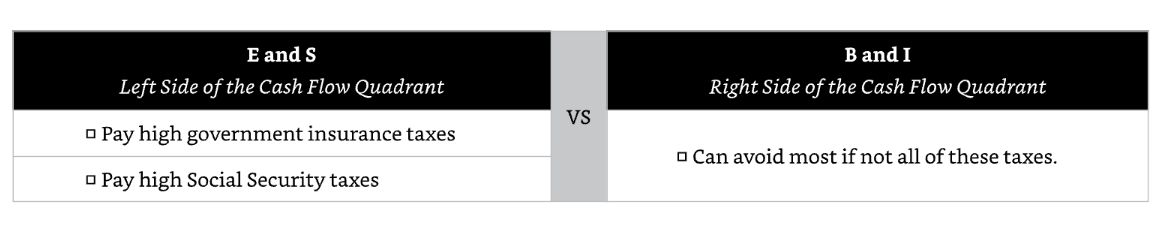
- Perhaps this is the reason I feel so strongly about the government not telling me what to do. I don’t mind them offering me incentives to be in business and to invest in real estate, oil, and gas. I love that. But what I hate is the government telling me that I have to contribute to Social Security and Medicare—especially since I’ll probably never use them.
-
Now, instead of being self-employed, Michael is an employee of his company, as well as an owner. As an owner, his share of the income is paid to him as a distribution of the company’s earnings. This amount is not subject to employment taxes. As an employee, his earnings for serving his patients are paid to him as salary. We want the salary portion of the money Michael makes from his company to be as low as possible and his distributions or dividends to be as high as possible so that he can pay the least amount of employment taxes. The government tax collectors understand this as well. So they want the salary to be, at the least, reasonable for the services Michael renders to the company.
-
Tax collectors are always on the lookout for salaries that are much higher or much lower than normal for your industry. If you take too low of a salary, the government may treat ALL of the income from your company as self-employment income subject to employment taxes.
-
Now in the United States, in particular, the type of company you form is going to be important for income tax purposes. You probably want to be taxed as an S corporation for your primary business. An S corporation is pretty simple to operate and avoids any potential double taxation that comes from operating your main business as a C corporation.
CHAPTER TWELVE: YOUR PROPERTY, SALES, AND VALUE-ADDED TAXES
-
There are as many exemptions and tax benefits in the sales and property tax rules as there are in the income tax law. These are taxes that many times are simply ignored by business owners and their tax advisors. We just come to accept them as normal. We have a tendency to complain a lot less about sales tax in particular than we do about income tax. Yet the dollars involved are enormous.
-
Purchases Not Subject to Sales Tax (In Many U.S. States): Purchases of Manufacturing Equipment, Purchases of Inventory, Purchases of Equipment used in Research and Development, Purchases of other Supplies
-
Sales tax should always be collected unless you have clear proof that no tax is due. Unpaid sales taxes can grow without your knowledge for many years. All companies should have a sales tax professional do a review of their collection requirements every few years.
-
Property tax is especially hard to swallow in difficult economic times, because property tax isn’t charged only if you make a profit. And it doesn’t necessarily go down when the value of your property decreases.
-
The property tax is usually calculated as a percentage of the value of your real estate. So the obvious way to reduce your property tax is to challenge the value placed on your property.
-
There are two ways to argue that your property should be valued at a lower figure than what the tax assessor says. One is to show that the value of your property is a lot less than what they say. You could get an appraisal, or, if the property is a rental property or used in your business, you may be able to use your reduced rental income and the reduced rents of similar properties as evidence that your property should be valued at a lower dollar value than it was valued at originally. Another way to pay less property tax is to show that your property is being valued at a higher dollar value than a similar property. In many cases, properties of similar use, size, and location are required to be valued the same.
-
Pay attention to the fact that your property tax bill states the time period within which you must protest or appeal the value placed on your property.
-
As a business owner, you pay sales tax on two basic types of transactions: items you buy for your business and products your company sells. Do you know which of these two transactions has the biggest effect on your bottom line? Most people would say that the items you purchase for your business are a bigger expense since you can’t pass on those taxes to your customers. The reality is that for most companies the bigger challenge is the tax on products you sell.
-
The reason is that if you don’t collect tax on products that you sell, and the state later audits you and assesses tax, the tax burden shifts from your customers to your business. For this reason, you should always collect sales tax unless you are sure that no sales tax is due.
CHAPTER THIRTEEN: ESTATE PLANNING IS GOOD TAX PLANNING
-
Estate Planning allows you to: a. Ensure your heirs have a painless financial experience, as well as leave your assets with your loved ones instead of the government.
-
Three Steps to Successful Estate Planning 1. Placing assets in trusts 2. Creating a will 3. Avoiding the estate tax
-
Probate is the process of changing an asset’s title (i.e., who owns them) from the person who died to that person’s heirs.
-
Probate is to be AVOIDED because: 1. It includes courts, judges, and lawyers 2. It’s expensive 3. It’s public (everyone knows)
-
There is an easy way out of probate in most countries. Make sure all of your assets are titled to a trust. You can be the trustee (owner) of the trust, and you can even be the beneficiary (the recipient) of the trust assets while you’re alive. The trust document says what will happen to the assets when you die. It’s basically your ticket to control your assets after death. Wouldn’t it be great for your loved ones to not have any arguments over who gets what? And to not have to go through probate, keeping your family matters private? You get all this and more simply by setting up a trust that owns all of your major assets.
-
Give and take with your charitable giving. If you have charitable intentions with your estate, then consider a charitable trust. With a charitable trust, you can give your assets to the charity now but still take the income stream from the assets for the rest of your life. You still get the income, but the value of the assets in the trust will avoid estate tax.
-
A Will can appoint a guardian for your children, specify the distribution of your assets, and specify any other special requests.
-
The obvious thing to do would seem to be to give your assets away, right? Well, that’s fine except for two things. One, you want to still control the assets while you’re alive in case you need them. And two, every country with an estate tax also has a gift tax that is at least as much as the estate tax. The gift tax is specifically created to nip this kind of behavior in the bud.
-
In your estate planning, give away assets where: 1. You give away value without giving away control 2. You can minimize the gift tax by giving away portions of each asset.
-
During my lifetime, all I care about is controlling the business or real estate—not whether I technically own it.
-
Outcomes of Setting Up a Limited Partnership. 1. You can give away assets (limited shares) to the limited partners, and as the general partner, you maintain control. 2. You can pay yourself a salary from the limited partnership. 3. Your estate gets BIG tax savings.
-
The second reason I like to give away business and real estate shares is that I can give more of them away than I can with some other assets, all the while not using up all of my exemption. I do this by giving away only a portion of each asset at a time, using a tool called a discount.
-
The first discount is called a “minority share” discount. It works like this. Suppose your business is worth $500,000 in total. That means that there is someone out there who would be willing to buy your business for that amount. Let’s say you decide to give away 20 percent of your business to your children. You might think that 20 percent of a $500,000 business is worth $100,000, right? Wrong. Because 20 percent won’t let someone have any say in what happens in the business, it’s worth a lot less than $100,000. It could be worth as little as $60,000. This is called a minority discount. This means that you could give away 20 percent of your business and you might only use up $60,000 of your exemption. That’s like getting an extra $40,000 exemption.
-
The portion or percentage you give away could be worth less than the actual figure, which means you only use a portion of your lifetime exemption.
-
People don’t like buying into a family business when they are not part of the family. There is a lot of risk that they may not know about. Or, the shares might have restrictions on who can buy them or at what price. So the courts allow a discount on the value of the shares. In summary, the marketability discount is allowed because it’s difficult to market and sell a partial interest in a closely held business.
-
Real estate works the same way as a business when it comes to value. So you can give a small or minority share of real estate away and still get a discount. In doing so, you end up with a smaller estate tax because you’ve given away some of your assets. And since you expect those assets to go up in value, it’s a really good deal to give them away early.
-
In most cases, you can completely eliminate the estate tax.
-
If you want the income from the assets for your lifetime and then want a charity to have the assets when you die, you should use a charitable remainder trust (CRT). In a CRT, you get all of the income during your lifetime. Once you die, the assets go directly to the charity. They don’t go through your will, since you don’t own them any more—the trust owns them. If you want the charity to get the income while you are alive and then you want the assets to go to your family when you die, you want a charitable lead trust (CLT). In a CLT, the charity gets the income while you are alive or for a specific number of years. When you die, your assets go to your family or anyone else you choose. The great thing about both of these trusts is that you get an income tax deduction for the donation in the year you set up the trust. In addition, with a CRT, you get an estate tax deduction for the full value of the assets when you die. Even in a CLT, you may get an estate tax deduction. These valuable tools require detailed set up and assistance from your tax advisor. Do not set them up by yourself. And be sure you talk to your family about what you are doing so that they aren’t surprised to find out that some of your assets are in a charitable trust.
CHAPTER FOURTEEN: REDUCING YOUR TAXES IN OTHER LOCATIONS
-
Basic Principles When Doing Business in Multiple Locations. 1. You’ll be taxed where you have property. 2. You’ll be taxed where you have an office. 3. You’ll be taxed where you have employees. 4. You may be taxed where you have contractors.
-
U.S. GENERAL STATE RULE: If you get benefits from a state, the state can tax you.
-
Every location has different tax rules, and paying tax in several locations can result in paying less total tax than you would if you did business in only one location.
-
In many cases, you can pay tax on as little as half of your income just by working the rules of the different tax locations against each other.
-
When structured properly, some of your business income can become “nowhere” income and escape state tax altogether.
-
Most countries allow a credit for taxes paid to a foreign country on income that’s earned in that country. The credit is usually the smaller of the amount of taxes you actually paid in that country or the taxes you paid in your home country on that income.
-
To receive the foreign tax credit, the same taxpayer (entity) who pays the tax in the foreign country has to report the income in the home country.
-
While each state has its own formula, all of the states’ formulas include what is called a sales factor. How many sales you have in the state helps determine how much of your income is taxed in the state. Whether a sale belongs in a state depends on where the product is shipped.
-
So, let’s say you have your main office in Arizona and you have a warehouse operation in Nevada. You don’t have any offices or employees anywhere other than in these two states. That means that when you do your Arizona tax return, you will only report sales shipped to Arizona. Since Nevada doesn’t have an income tax, all other sales will be “nowhere” sales. So you end up being taxed on only a small portion of your income in Arizona and you aren’t subject to tax in any other state.
PART TWO: YOUR TAX STRATEGY FOR TAX-FREE WEALTH
CHAPTER FIFTEEN: PLAN TO TAKE CONTROL OF YOUR TAXES: ENTITIES
-
Taxes are important but not nearly as important as personal and business goals. Make sure your tax planning doesn’t interfere with personal, wealth and/or business goals.
-
Limited partnerships are good to use when one person is in charge of the business and the others are passive investors. They also work well as part of an estate plan in which children or grandchildren are the limited partners and the parents or grandparents are the general partners. This is one way to transfer partial ownership of some assets to the younger generation while keeping control of the assets in the hands of the older generation.
-
Each of these entities has a place in your tax strategy. For example, you may want to use an LLC to own your real estate investment properties, a corporation (or LLC taxed as a corporation) to own your business, and a limited partnership to own assets you want to transfer to your children. And you likely will want to use trusts to protect assets you set aside for your children from creditors and others, particularly while they’re young.
-
One of my favorite tax strategies is to combine different entities into a single strategy. Let me give you one good combination—a partnership and two S corporations. Let’s suppose you and your friend decide to open a business selling widgets. You would like to have the self-employment tax benefits of an S corporation. You are a little worried, though, about some of the corporate tax rules and are thinking that maybe you would like a partnership. Which one do you choose? Why not choose both? Why not own the business in an LLC taxed as a partnership and then own your interest in the partnership through an LLC taxed as an S corporation.
-
The benefits of this combined entity structure are huge. Because you own the business as a partnership, you can distribute income differently than you allocate income.
-
Since they will be in the 35% income tax bracket, the $100,000 deduction lowers their income tax by $35,000. In total, simply by owning their business through S corporations instead of directly through a partnership, they lower their taxes by about $70,000 between the two of them. This is the magic of a good tax strategy.
CHAPTER SIXTEEN: PROTECT YOUR WEALTH FROM PIRATES, PREDATORS, AND OTHER PLAINTIFFS
-
I love Robert Kiyosaki’s definition of an asset. He says that an asset is something that puts money in your pocket. Anything else is a liability because it takes money out of your pocket. So by this definition, your home is not an asset because it takes money out of your pocket and doesn’t put money into it. On the other hand, your business or investments (including investment homes) can be assets if they produce cash flow.
-
The rules for protecting your assets are fairly simple. You have three goals. Goal #1. Prevent a lawsuit. Goal #2. Stay under the radar so that you are less likely to be sued. Goal #3. Win any lawsuit.
-
General partnerships are awful.
-
General partnerships offer no protection from plaintiffs. You are responsible (liable) for everything you do, everything your partner does, and everything your employees do. When someone sues a general partnership, they also sue all of the partners.
-
Limited partnerships can be good for estate planning and for businesses where only one or two of the partners are running the business and the rest are passive investors.
-
Corporations are good entities for protecting you from any lawsuits that are directed at the company. As a shareholder, you cannot personally be sued unless you personally did something wrong. You’re a bit like a limited partner, because all you can lose is the amount you have invested into the business.
-
Limited liability companies (LLCs) can be the absolute best way to protect your business and investment assets from lawsuits. They give you the protection of a corporation. You can only lose what you put into the company. But they actually give you more protection than a corporation if you’re personally sued.
-
Be sure to have both an attorney and a CPA help you with your entity structure.
CHAPTER SEVENTEEN: PLAN TO RETIRE RICH, NOT POOR
-
In the United States, if you put your money into a Roth IRA or Roth 401(k), you don’t get a deduction when you put your money into the plan and you don’t pay tax when you take it out.
-
Let’s begin with the lie contained within their basic premise of these retirement plans. They presume that when you retire, you will be in a lower tax bracket than you are when you are working. The only way this could possibly be true is if your goal is to retire poor. If you plan on retiring with even the same amount of income you have while you are working, you will be in a higher tax bracket when you retire.
-
The reason for this is that while you are working, you can take advantage of a whole host of tax benefits. Let’s start with the tax benefits you get for your children. When you retire, your children are no longer dependent on you (if you’re lucky), so you don’t have that tax benefit. While you are working, you probably pay interest on a home mortgage. When you retire, you hopefully have paid off your mortgage, so you no longer have that deduction. While you are working, you likely have business deductions or employment-related deductions. These obviously go away when you retire.
-
There are people who say that the fact these deductions go away is precisely why you don’t need as much income when you retire as you do while you are working—the point being that you don’t have to pay for kids, a mortgage, and business expenses when retired. That may be true if you plan to just sit around the house and watch television when you retire. If you’re like most people, however, you’ve put off a lot of life’s pleasures while you were working in hopes to enjoy them in retirement when you have more time. These pleasures may simply be more rounds of golf or more travel. Or, you may have always wanted a house in the mountains or on the beach. These are additional expenses that you didn’t have when you were working. Plus, you’ll probably have cute grandchildren who need to be spoiled.
-
When you invest in the stock market through a qualified retirement plan, like a 401(k), all of the income you earn is eventually taxed at the regular tax rates. So, instead of the preferred capital gains rate, that same income is taxed at ordinary income rates when you withdraw it from your retirement plan. This alone can more than double the tax rate on your investment earnings.
-
If you were to make this same investment in a government-regulated retirement plan like an IRA, you lose this $2,000 of tax savings because the depreciation deduction gets trapped inside the IRA.
-
I love self-managed Supers and Roth IRAs for certain types of investments, just not for an investment like rental real estate that can be a great tax shelter when it’s owned outside of a retirement plan.
-
Leverage is the difference between building massive amounts of wealth and barely getting by in retirement. Leverage, in the form of mortgages, is what makes real estate such a good investment. Without debt, real estate is a mediocre way to make money. The returns on investment are no better than buying and holding stock.
-
The same is true for business. With leverage, business can be a great investment. You can borrow to improve your return on your equipment. You can borrow to purchase the business. And, of course, the best leverage in business comes from leveraging your time by hiring employees. Like real estate, without leverage, business is just a mediocre investment.
-
However, in the United States, when you leverage your investments inside your retirement plan, the income earned inside the plan is taxed when it’s earned. You lose the tax-deferred benefit of the qualified plan. So even if the stock brokerage will give you leverage, your retirement plan ends up paying tax on the earnings because of the leverage.
-
First, you increase your tax rates. Second, you increase your risk since you are leaving your money in the hands of someone else. Third, you reduce your overall returns because you are limited in using leverage. And fourth, you lose control over what you can do with your money and when you can use it.
-
While most government-qualified plans are horrible for permanent tax savings, there are certain government-qualified plans that do work. In the United States, these plans are called Roth IRAs and Roth 401(k)s. I don’t love Roth 401(k)s because there are still too many restrictions on them regarding investment options and distributions from them. But Roth IRAs can be a very good part of a tax strategy, provided that the type of investments that work in a Roth are also the types of investments that are part of your wealth strategy.
-
We recommend that you focus on a single type of asset. Begin with the asset class you are going to use, whether business, real estate, paper, or commodities. Once you have the asset class figured out, choose which type of investment you want to use within that asset class. For example, if you choose paper assets, then decide which type of paper assets you are going to use to build your wealth. Are you going to use stocks, options, futures contracts, or maybe hard money loans? Once you have decided on the asset you are going to use for building wealth, then you can decide how to get the best tax benefits from using that asset. As we discussed earlier in this chapter, if you choose multifamily housing as your asset, then you won’t want to use a government-qualified retirement plan to hold your wealth. That would be putting a tax shelter inside another tax shelter.
-
Assets that work well in a Government Qualified Plan: 1. Tax Liens 2. Hard Money Loans 3. Stock Trading 4. Gold and Silver Bullion 5. Cryptocurrency.
CHAPTER EIGHTEEN: BUSINESS CAN BE YOUR BEST TAX SHELTER
-
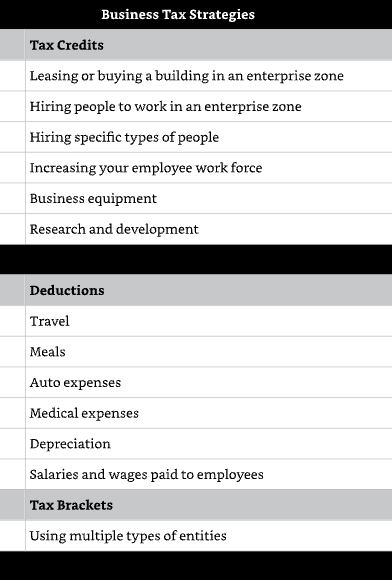
Employment credits are a favorite tool of governments to encourage companies to hire more people or certain types of people. Many governments give credits for hiring people who have been unemployed for a long period of time.
-
Of course, the obvious benefit is that you get to deduct salaries and wages paid to employees. You may also decide you want to give certain employees stock options (the option to buy stock at a lower price than if they bought it in the stock market). Typically, you can deduct the value of these options as soon as the employees have the right to exercise (use) them. Or, you may be able to give the employees a special benefit by using qualified stock options, sometimes called “incentive stock options,” or ISOs. These allow the employees to receive the options without paying ordinary income tax.
-
So you could have your business year-end on March 31 even though your personal tax year ends on December 31. This might give you some flexibility about when you pay taxes on your income. For example, you could pay yourself a bonus in March. Your company could deduct the bonus for their year that ends that March while you don’t have to personally report the income until you file your tax return for the following year that ends on December 31.
-
As we discussed in Chapter 8, there are different types, or buckets, of income. Portfolio income, or income from investments, is always better than ordinary income. The reason Warren Buffet pays only 17 percent on his income is that most of his income is investment income. An even better type of income is passive income. When you have passive income, you can offset your income with losses from your real estate investments.
-
All we have to do is to give part of your business to a member of your family who doesn’t work in the business. When we do this, their share of the income from the business is passive income. Then, we also give them a part of the real estate that has passive losses. Now, their share of the real estate losses will offset the passive income from their share of the business. While this is simple in concept, don’t do this without your tax advisor’s help. There are lots of details that your tax advisor will need to be aware of so you can make this great tax strategy work for you.
-
In the U.S. tax law, there is a little-known provision that allows the owners of a business to completely avoid tax when the company is sold. The rule is called Section 1202 stock.
CHAPTER NINETEEN: THE MAGIC OF REAL ESTATE
-
Real estate is such a good tax shelter that a serious real estate investor should never have to pay tax on their cash flow or on the gain from the sale of their real estate.
-
The key to building tax-free wealth in real estate, of course, is to continue buying more and more real estate. Here’s why. In our example of cost segregations in Chapter 7, you learned how to get more of your depreciation in the first several years of owning the property. Your tax basis (the purchase price of the property less all of the depreciation you have taken on the property over the years) in the property is reduced dollar by dollar for the depreciation you take. And your tax basis is important both for calculating depreciation and for calculating your gain when you sell a property. Once your tax basis in a property goes to zero, you don’t get any more depreciation. And when you sell the property, your gain is calculated as the difference between your tax basis and your sales price. This is a basic accounting principle that applies throughout the world. In order to continue sheltering the cash flow from your real estate as well as the cash flow from your business, you need to continue buying more real estate by rolling your gains into like-kind properties through tax-free exchanges. One of the great things about tax basis is that it includes debt. So you can buy a property with no money down and you get all of the tax basis and depreciation.
-
In many countries, however, you can completely avoid the gain on the sale of your property, including the depreciation recapture, simply by buying another investment property for the same price or more than the one you sold through a tax-free or like-kind exchange—also referred to as a Section 1031 exchange in the United States after the section of the Internal Revenue Code that allows this tax treatment. This means that you can sell properties that you don’t want any more because they are overpriced or because you want to change your investment strategy and not have to pay any tax.
-
Like-kind exchanges + depreciation = zero taxes.
-
Suppose you decide to begin your real estate investment strategy by investing in single-family homes. You buy several homes over the next few years and get comfortable buying houses that have positive cash flow while also increasing in value. After a few years, you decide that you’d like a little more cash flow and a few less properties to manage. So, you sell all of your houses and buy a couple of apartment buildings. You do this through a “qualified intermediary” and you follow all of the detailed rules of Section 1031 that your tax advisor tells you about so that your sales and purchases qualify as a like-kind exchange. You enjoy the additional cash flow that comes from your apartment buildings for several years. You also enjoy the depreciation deductions from your apartment buildings. These deductions, as we discussed in Chapter 7, completely shelter the cash flow from income tax. Eventually, though, you decide that you want to cash in your apartment buildings for an asset that you don’t have to manage at all. You notice that while apartment buildings are far easier to manage than single-family homes and produce more cash flow than single-family homes, they still require a lot of of work. You look around for a building that doesn’t require any work at all. What you find is a Walgreens.
-
Like many retail stores, Walgreens typically doesn’t own properties. Instead, it finds the land, builds the building, sells the land and building to an investor, and then leases them back for 30 years. Walgreens agrees to take care of all of the maintenance and all of the expenses. All the investor has to do is pay the mortgage. You like this because Walgreens has great credit and the bank is happy to lend you the money to buy a property that has a lease guaranteed by one of the largest retail store chains in the world.
-
Here is the magic of the Walgreens strategy. Over the years, you took depreciation deductions on your single-family homes, then on your apartment buildings, and then on your Walgreens. This depreciation sheltered your cash flow from income taxes. Let’s suppose your total depreciation deductions over the years were $4 million. You have to reduce your tax basis in your properties by all of that depreciation. Remember that tax basis is the number that is used to calculate the capital gain when you sell the property. So, if you paid $5 million for the Walgreens, and you had a total of $4 million of depreciation, then your basis would be $1 million. If you sold the property for $6 million (it’s value) on the day before you died, you would pay capital gains tax on $5 million ($6 million sales price less your $1 million basis). If your capital gains tax rate is 20 percent, you would have to pay a tax of $1,000,000. You can eliminate this capital gains tax simply by holding onto the property until you die. When you die, your basis is automatically increased to the value of the property on your date of death. This is called a basis step up. If the value is $6 million, your basis will be $6 million. Since we know that your kids are going to sell the Walgreens soon after you die so that they can have the cash, this is a great tax-planning tool. You got the tax benefit from all that depreciation while you were alive, and your children don’t have to pay tax on it when you die.
-
Selling assets creates unnecessary capital gains taxes that could be avoided simply by holding onto your assets until after you die. You can always get cash from your real estate by borrowing against it and debt is tax free.
-
One of the biggest benefits in real estate is that loans aren’t taxable.
-
So you can borrow money from the bank through a refinance and you won’t pay tax on that money.
-
In the United States there is no tax on the sale of a personal residence so long as you live in it two out of the past five years. My friend and her husband always live in their house until it’s fully improved.
CHAPTER TWENTY: STOCKS CAN LOWER YOUR TAXES TOO
-
People who make a lot of money in the stock market are well educated about the stock market. They understand how to make money whether the market goes up, down, or sideways. They don’t rely on the strategy I used for my first stock investments—buy, hold, and pray the stock goes up. Instead, they understand how to use options, futures, and other hedges to reduce their risk and increase their reward.
-
If you invest in mutual funds, you will likely buy into a fund that has been around for many years. Over the years, investors have come and gone while the fund has purchased many different stocks over those same years. The challenge comes when the fund goes to sell a particular stock. Let’s say you decided to invest in Mutual Fund A at the beginning of the year. The fund bought Stock B for $10 per share fifteen years ago. When you joined the fund at the beginning of the year, Stock B had a market value of $50 per share. The day after you join the fund, the fund managers decided to sell the stock. So there is a gain to the fund of $40 per share on the sale of Stock B. Who pays the tax on the $40 gain? You do, even though you just joined the fund the day before. All investors who owned shares of Mutual Fund A on the day the mutual fund sold the stock share the gain. Doesn’t seem fair, does it? It gets worse. Suppose you paid $100 per share for Mutual Fund A when you bought it in January. At the end of the year, the stock market takes a dip in value and now your shares of Mutual Fund A are only worth $80 per share. You still have to pay tax on your share of the $40 gain from the sale of Stock B inside the mutual fund.
-
The way to make them deductible is to make them an ordinary and necessary business expense. This is difficult to do when you are a stock investor, since you probably aren’t investing for other people and so are not technically in business. There is an exception to the business requirement, however, for people who are in a trade. A trade includes doing work only for your own benefit so long as it is a major part of your time and wealth building activities. When you are in a trade, you get to deduct your expenses just like you would if you were in business. For stock traders, this is even better than for the typical business owner. You get to deduct your expenses as ordinary deductions, and your trading gains are capital gains—not ordinary income, which is taxed higher. If you don’t meet the trader rules, then your expenses are investment expenses.
-
Whether you qualify as a stock trader is based on your facts and circumstances. The court cases are constantly changing the rules for stock trader qualification so be sure your tax advisor researches these cases each year you want to qualify as a trader.
-
Three Rules to Qualify as a Stock Trader: 1. The volume of trading activities must be significant in both number of trades and dollar amount of trades. 2. The time spent on your trading activity must be a significant part of the day. 3. The income resulted from your trading activity must be a significant portion of your income.
-
Since stock and option trades are treated as short-term capital gains, if you were to trade them outside of your IRA, they would be taxed at ordinary income tax rates. So you don’t give anything up by trading inside an IRA. You simply postpone paying the tax on the investment gains. Even better is trading stocks and options inside a self-directed Roth IRA. When you do this, none of the gains are taxable—ever! How cool is that? Of course, remember that you are limited on when you can take the money out, so don’t depend on the income from the stock and option trading inside your IRA while you are under 59½ years old. This is retirement income, and you should trade accordingly. If you have money inside a 401(k) or an IRA, and your wealth strategy includes stock and option trading, consider rolling your 401(k) or IRA into a self-directed IRA and doing some of your trading inside your self-directed IRA. And consider converting your regular IRA to a Roth IRA before you start trading so that you can avoid tax on all of the gains from trading.
CHAPTER TWENTY-ONE: COMMODITIES CAN BE YOUR TAX FRIEND
-
In the U.S., oil and gas is one of the truly great tax shelters.
-
Four Types of Oil and Gas Investments Type Tax Benefits: 1. Buy stock in an oil and gas company. No 2. Buy an interest in the royalties from a producing oil and gas well. No 3. Invest in exploratory operations, also called “wildcat” drilling. Yes 4. Invest in development operations.
-
When a development company drills for oil and gas, it has two main categories of expense. The first is the equipment it purchases to drill. This is usually about 30 percent of the cost of drilling a well. The second is intangible drilling costs (IDC). IDC includes all of the other drilling expenses, including labor, survey work, ground clearing, drainage, fuel, and repairs. These expenses normally would be a cost of the well and would be depreciated or amortized over the life of the well. However, Congress decided to allow people to deduct both their IDC and their equipment costs in the year they spend the money, which is usually the first year of investment in the drilling operation.
-
This isn’t the only tax benefit for investing in oil and gas. You also get to deduct 15 percent of the well’s gross income each year. This is called depletion. It’s like depreciation, only you get it every year, even after you have deducted all of the IDC and the equipment costs.
-
In order to get all of the IDC and equipment deductions to which you are entitled, you have to own your investment through a general partnership or sole proprietorship. You can’t own it through a corporation, LLC, or limited partnership.
-
Mining operations have similar tax benefits to oil and gas development.
-
Another type of energy that gets special tax benefits in most countries is renewable energy. Renewable energy includes wind turbines, solar energy, and electric cars. Governments love to encourage investment in new sources of energy. Tax benefits include investment tax credits for investing in wind turbines (windmills), credits for buying solar panels, and credits for buying electric cars or even for buying hybrid gas/electric cars. Some U.S. states also provide huge tax credits for investing in solar energy. And, so long as the equipment is used in business, 100% is deductible in the year it is purchased.
-
The most important tax benefit is the tax deduction for all of the expenses of running a farm, orchard, or ranch. This includes feed for livestock, seeds, and labor. So, you don’t have to add any of these costs to your inventory (crops or livestock). You get to deduct them whenever you spend the money on them.
-
Farms also get special treatment for estate tax purposes, as well. You may get to reduce the amount of estate tax you pay when you inherit a farm or may get to pay the estate tax over several years. The government wants to keep farms and ranches in business, so they give you tax breaks so that you don’t have to sell the farm to pay taxes. When you decide to invest in agriculture, be sure to look for special tax breaks for certain crops. In the United States, for example, citrus groves get specific tax breaks.
-
United States tax policy doesn’t promote ownership of gold and silver. Instead, investment in precious metals are discouraged by providing a special, higher tax rate than other long-term capital gains tax rates.
CHAPTER TWENTY-TWO: DON’T FEAR THE AUDIT
-
Preparing for an Audit:
- Step 1. Maintain organized bookkeeping records.
- Use good accounting software, record your business income and expenses, prepare income statements (timely updates), prepare balance sheets (timely updates), record your personal income and expenses, create budgets and forecasts, create reports, and compare income and expenses between years.
- Step 2. Maintain and organize receipts.
- Keep receipts for deductions you intend to take on your tax return, scan receipts into organized files in your computer or create separate paper file folders for each type of receipt, and maintain receipts for 7 years.
- Step 3. Be prepared with other documents.
- Legal contracts or agreements, copies of tax returns, corporate books (for your business) that include: articles of Incorporation or Organization, Operating or Partnership Agreement, By-Laws, and Minutes.
- Step 1. Maintain organized bookkeeping records.
-
What you call the deduction on your tax return is important. Instead of listing the expense as a seminar, why not list it as continuing education? Or, if you went primarily to network and market yourself to the other participants, why not call it a sales or marketing expense? You’re still telling the truth and reporting your seminar expense accurately. Only now you aren’t raising a red flag and inviting the government to come audit you. You also have to be careful when you are estimating expenses. Suppose you paid cash for some of your expenses and you don’t know the exact cost. Most people will choose a round number to report on their tax return. This is a mistake. Choose a number that is closer to being, or at least looking, precise. When you do that there is less of a chance of someone looking at your return thinking you guessed at your number.
CHAPTER TWNTY-THREE: CHOOSE THE RIGHT TAX ADVISOR AND PREPARER
-
Being passionate about reducing your taxes is only one of the traits to look for in a good tax advisor. Another is how the advisor looks at the tax law. Is the advisor afraid of the law or does he look at it as an opportunity?
-
The reality is that you have all of the answers. Your advisor should have all of the questions. Don’t worry about what questions you should ask your tax advisor. If you have to ask the questions, then you simply have the wrong advisor.
-
Characteristics of a Good Tax Advisor:
- Fully educated about the tax law.
- Passionate about reducing your taxes.
- Embraces the law as an opportunity.
- Focuses on permanent tax savings.
- Uses creativity in applying the law in your favor.
- Considers the entire law when reducing taxes, not just a single rule of law.
- Cares more about you than himself or herself.
- Asks you questions about your specific situation.
- Willing to teach you the tax rules.
CHAPTER TWNTY-FOUR: WHAT ARE YOU GOING TO DO WITH ALL YOUR EXTRA MONEY?
-
There are three concepts that you must understand in order to produce massive amounts of wealth: Compound Interest, Leverage, and Velocity. These are the three basic principles on which all great wealth is founded.
-
It’s clear that compounding your interest is important. It should also be just as clear that it’s a pretty slow way to build wealth.
-
Leverage: Leverage is what happens when you earn interest on not just your money but also on someone else’s money. This is precisely what the bank does when it borrows your money. When would a bank borrow your money? Every time you put your money in the bank, it’s borrowing your money.
-
Now what does the bank do with your money? It lends it out to someone else at a higher interest rate than what it pays you. This is called leverage.
-
Let’s say you borrow $100,000 from the bank for your business. The bank may charge you 8 percent interest on this loan. You take this $100,000 and buy equipment and inventory that will create income of $12,000 per year. You pay the bank 8 percent, or $8,000, and your net income from borrowing this money is $4,000. You have just used leverage in much the same way as the bank.
-
Compare that to the $500 that you would’ve earned if you’d only put your money into the bank’s CD. That’s the magic of leverage!
-
You could’ve earned still more by using the principle of velocity. Think about it this way. Leverage is really just compound interest using someone else’s money. Velocity is a way to increase your leverage.
-
Let’s say you borrow the $100,000 from the bank to add to your $10,000 to invest in your business. One of the reasons the bank has agreed to lend to you is that you have put some of your own money into the business. This is called having skin in the game. After the first year, you have earned a total of $13,200 on that money at 12 percent. You have to pay the bank its interest of $8,000, so you are left with just over $5,000. Now if the bank was willing to lend you $100,000 so long as you put in $10,000, then the bank should be willing to lend you another $50,000 because you now have another $5,000 invested of your own money in the business. This is true even though that $5,000 came from business earnings. Banks like to see you leave earnings in the business. These are called “retained” earnings because you retain them in the business.
-
With the additional $50,000, plus the $5,000 you have from your first-year earnings, you can earn another 12 percent. You still have the original $110,000, so you earn 12 percent on that money, too. In the second year, you will now earn $19,800 ($165,000 multiplied by 12%). You have to pay the bank its interest of 8 percent on the total loan of $150,000, or $12,000. This leaves you with net earnings in the second year of almost $8,000. That’s $3,000 more than you earned the first year.
-
It’s all about momentum. The more you leverage and the faster you re-employ your money, the faster you will build your wealth.
SUMMARY
TAX STRATEGIES
****Tax Strategy #1 - Include Tax Planning in Your Wealth Strategy Tax Strategy #2 - Invest Where you Travel Tax Strategy #3 - Elect How Your Limited Liability Company will be Taxed Tax Strategy #4 – Deduct your Meals Tax Strategy #5 – Put Your Family to Work in Your Business and Investing Tax Strategy #6 – Document, Document, Document Tax Strategy #7 – Cost Segregations of Business and Rental Properties Tax Strategy #8 – PIGS are your PALS Tax Strategy #9 – Make Your Parents Your Business Partners and Reap the Tax Benefits Tax Strategy #10 – Saving for Your Child’s Education with Maximum Tax Benefits Tax Strategy #11 – Reduce the Wages You Take from Your Business Tax Strategy #12 – Reduce Your Sales Tax Burden Tax Strategy #13 – Reducing Your Estate Taxes through Charitable Trusts Tax Strategy #14 – Being Taxed in Multiple States or Countries Can Seriously Reduce Your Taxes Tax Strategy #15 – Use a Combination of Entity Types to Reduce your Taxes Tax Strategy #16 – Include Asset Protection Planning When You Create Your Tax Strategy Tax Strategy #17 – Use a Roth IRA for Certain Wealth Strategies Tax Strategy #18 – Turn Your Business Into a Passive Investment Tax Strategy #19 – Change Your Residence Every Few Years Tax Strategy #20 – Do Your Stock Trading inside a Self-directed Roth IRA Tax Strategy #21 – Avoid the Passive Loss Rules on Oil and Gas Investments Tax Strategy #22 – Purchasing an Audit Defense Plan Tax Strategy #23 – Hiring the Right Tax Advisor Tax Strategy #24 – Build Massive Passive Income through Your Tax Savings
TAX TIPS
TAX TIP: Include tax planning in your wealth strategy. Remember that it's not just what you make that matters, it's what you keep. When you keep taxes in mind as you invest, you end up keeping more money and make better investment decisions.

TAX TIP: Invest where you travel. Do you have a favorite destination? Consider investing in the area. It gives you a great reason to keep returning, and you turn the travel expenses you already have into deductible expenses, keeping more money in your pocket.

TAX TIP: Learn how your LLC (limited liability company) can be whatever it wants to be. The LLC has become the entity of choice for asset protection purposes. But what about tax purposes? Your LLC can be whatever it wants to be —a sole proprietorship, a partnership, a C Corporation, or an S Corporation. This flexibility gives you the best of the tax and asset protection worlds. In some countries without LLCs, the LLP (limited liability partnership) may give you similar flexibility.

TAX TIP: Eat while you work and save taxes. Business meals are a great way to spend time with employees, clients, and customers. You can discuss business and turn your meal expense into a deductible expense.

TAX TIP: Put your family to work. Make your business a family business. Then when you travel for business, your family's travel is deductible. And you can shift income from your higher tax bracket to their lower tax bracket. This creates permanent tax savings.

TAX TIP: Document. Document. Document. The IRS, Revenue Canada, the HMRC, ATO, and other tax collectors love documentation. Remember that if you pretend to document a deduction, you get a pretend deduction.

TAX TIP: Avoid the tax collector's traps. The trick is to properly document the values of all the items you depreciate in a cost segregation or chattel appraisal even better, have a tax professional or engineer document them for you. Without it, the tax collector can make your tax savings from depreciation disappear. Protect your tax savings with good documentation.

TAX TIP: Modify your investment strategy. Some real estate investments have "built in" tax savings that don't require you to do anything extra to write off the losses against any other income you have. Oil and gas are examples of these investments, where as much as 100 percent of the investment can be written off in the first year.

TAX TIP: Partner with your Parents' lower after-tax dollars. Form an LLC and have your elderly parents become members. You can give a portion of your LLC to your parents and the income will be taxed at their lower tax rates.

TAX TIP: Watch out for traps. Many education savings vehicles permit earnings to grow tax-free and distributions to be taken tax-free. While this sounds like a great idea, be sure to take a closer look. Often, these education savings vehicles severely limit your investment options and how the funds can be used. This can in turn limit the overall earning potential and work against the goal of making your child's education more affordable. Understanding how education savings vehicles work can help you maximize your overall earning potential.

TAX TIP; Don't pay yourself too much or too little. Too much salary may mean overpaying payroll taxes. But too little salary and your company could be a target for an audit. Reduce your chances of audit by paying a reasonable salary. It can save you over $4,500 in annual employment taxes and reduce your chances of audit.

TAX TIP: When in doubt, collect it. Not sure if your business needs to collect sales tax? When in doubt, collect it, remit it, and file a tax return. The cost is minimal but the result is substantial, because it significantly reduces your exposure.

TAX TIP: Give and take with your charitable giving. If you have charitable intentions with your estate, then consider a charitable trust. With a charitable trust, you can give your assets to the charity now but still take the income stream from the assets for the rest of your life. You still get the income, but the value of the assets in the trust will avoid estate tax.

TAX TIP: Operating in multiple states can work to your benefit. Doing business in states that have low or no income tax rates can help reduce your overall state taxes. When structured properly, some of your business income can become "nowhere" income and escape state tax altogether.

TAX TIP: Have a business partner? Form your own entity taxed as an S Corporation and have that entity be the partner in your business rather than you personally. This structure will reduce your self-employment taxes and provide maximum flexibility to you and your partner.

TAX TIP: Combine your tax strategy with an asset protection strategy. The two go hand in hand. In the end, you will have a strategy that protects you both from the government and from potential plaintiffs.

TAX TIP: Roth IRAs can be very useful for certain types of investments. Develop your wealth strategy first and then decide whether a Roth IRA works within your wealth strategy

TAX TIP: Turn your business into a passive investment. When you do, you can use your real estate losses to offset the income from your business.

TAX TIP: Since there is no tax on the sale of your residence in most countries, you may want to sell your residence and buy a new one every few years. While a personal residence is always a liability since it takes money out of your pocket, you can still make money on it if you buy and sell at the right times. Just don't get caught in the speculation trap of buying a home for the primary reason of selling it later. Buy your home because you want to live there. Any gain is just a bonus.

TAX TIP: Consider trading stocks and options in your self-directed IRA or pension account. The tax benefits can be enormous.

TAX TIP: Invest in oil and gas and you can avoid passive loss rules. Oil and gas is the only investment where you aren't subject to the rules that limit losses from passive investments.

TAX TIP: Purchase an audit defense plan every year. Some tax preparers offer an audit defense plan. This is a powerful way to keep a strong handle on your out-of-pocket costs and take the worry out of the cost of professional fees during an audit.

TAX TIP: Hire the right Tax Advisor. This doesn't just require knowing the right questions to ask a potential tax advisor. It means knowing what questions your tax advisor should be asking you.

WEALTH TIP: Use my simple formula to create massive passive income. Start with earned income, invest in growth assets, create a huge amount of capital from your growth assets, and then invest in assets that generate passive income. With a substantial amount of capital, even investments with modest returns result in massive passive income.
RULES TO REMEMBER
RULE #1: It's your money, not the government's.
RULE #2: The tax law is written primarily to reduce your taxes.
RULE #3: The fastest way to put money in your pocket is to reduce your taxes.
RULE #4: Everything you do either increases or lowers your taxes
RULE #5: The tax law is a series of incentives for entrepreneurs and investors.
RULE #6: You can deduct almost anything given the right circumstance.
RULE #7: It's not how much you own that matters, it's how much you control.
RULE #8: Treat your business just as you would if it were a big public company.
RULE #9: All tax planning must have a business purpose other than reducing taxes.
RULE #10: When you want to reduce a tax, reduce the base on which it's measured.
RULE #11: Every location has different tax rules, and paying tax in several locations can result in paying less total tax than you would if you did business in only one location.
RULE #12: To receive the foreign tax credit, the same taxpayer (entity) who pays the tax in the foreign country has to report the income in the home country.
RULE #13: Taxpayers with long-term, flexible tax strategies will always pay less tax than those without strategies.
RULE #14: You must maintain control of your assets at all times and in all circumstances.
RULE #15: Never ever put a tax shelter investment inside another tax shelter.
RULE #16: The single best tax shelter in most countries is investing in rental real estate.
RULE #17: Mutual funds are one of the few places where you can lose money and still owe tax on your investment.
RULE #18: The better the tax benefits, the more complicated the rules.
RULE #19: You can eliminate your fear of a tax audit simply by being prepared.
RULE #20: Never try to handle a tax audit yourself. Always enlist the assistance of your tax advisor.
RULE #21: The more passionate you and your advisor are about reducing your taxes, the lower your taxes will be.
RULE #22: It's not how much your tax preparer charges you that matters; it's how much your tax preparer costs you.

ESTATE TAX RULE #1: The lower your assets' value, the lower your estate tax.
ESTATE TAX RULE #2: There is a portion of your assets that are not taxable (this is called an exemption).

U.S. GENERAL STATE RULE: If you get benefits from a state, the state can tax you.
KEY POINTS FROM EACH CHAPTER
CHAPTER 1:
1. Become one of the wealthy and stop giving the IRS your time. Learn to trade your money for time and engage in activities the government uses to shape the economy. Remember, the tax law is a series of incentives for entrepreneurs and investors.
2. Taxes are based on your facts and circumstances changing your facts will change your tax.
CHAPTER 2:
1. It's time to take action on reducing your taxes. Don't be the average person paying 30 to 50 percent or more of your hard-earned income through income, sales, value- added, payroll, estate, or property taxes start by learning the basics of the tax law.
2. Become part of the privileged class of taxpayers by learning how the tax law can work for you and how you can easily pay 10 to 40 percent less in taxes.
CHAPTER 3:
1. Some of us are trained to believe we owe the government OUR money (it's just not true).
2. The tax code is set up to help us reduce our tax burden and to do so legally.
3. Nearly all—99.5 percent —of the tax code exists solely for the purpose of saving you money.
4. All of the so-called complexity of the tax law is aimed at reducing your taxes, not increasing them.
CHAPTER 4:
1. There is one way to put cash in your pocket almost immediately: reducing your taxes.
2. Learn how to make everything you do decrease your taxes.
3. Learn how to change your expenses from a personal expense to a business deduction.
CHAPTER 5:
1. The Cashflow Quadrant is a terrific diagram that shows the four ways people earn income, which has huge implications for your taxes.
2. Those on the E and S side of the quadrant don't experience the tax benefits of those on the B and I side unless they behave like the B and the I side.
3. Governments steer economic behavior through the tax code. They reward desired behavior with tax breaks. That's why reducing your taxes is actually patriotic.
4. You can easily shift the way you earn income to the B and I side of the Cashflow Quadrant and begin to enjoy the tax breaks.
CHAPTER 6:
1. Most people are average taxpayers who only experience average tax benefits.
2. The key to saving more in taxes is becoming a super taxpayer and enjoying the benefits of deductible expenses.
3. The best way to enjoy deductible expenses is to start a business or to start investing for passive income. You don't have to quit your job. Just start small.
4. One of the best business and investing practices is to document your income and expenses, and to document them well.
CHAPTER 7:
1. Depreciation is like magic. It creates money out of thin air.
2. Deductions over a set number of years on hard assets such as buildings are called depreciation. Deductions over a set number of years for intangible assets such as recipes are called amortization.
3. Many people don't take full advantage of their depreciation and amortization deductions either because of ignorance or laziness—or both — on their part or their accountant's part.
4. Ultimately, you're the one responsible to make sure you're not cheating yourself. Always double-check your return.
CHAPTER 8:
1. The more money you make, the more concerned you should be where it's coming from.
2. Certain types of income, such as earned income, are taxed at higher rates than other types of income, such as passive income.
3. One particularly good estate and tax planning strategy is like-kind exchanges whereby you can exchange one similar asset for another one tax-free.
4. The rules on many of these tax strategies are detailed and the work involved in properly balancing your income and expenses is intensive. Hiring a good accountant will be very helpful to you and will allow you to focus on your business and investments.
CHAPTER 9:
1. A great way to reduce your taxable income is to take advantage of the tax brackets.
2. By giving a portion of your business to your children and family, you can reduce the overall tax burden for you personally and take advantage of lower tax brackets.
3. You can divide your business among family and partners without losing control by making sure your agreements are clear and by utilizing legal tools such as trusts. It's not how much you own that's important—it's how much you control.
4. By creating a service company to handle things such as human resources and marketing, you can significantly lower your taxes.
CHAPTER 10:
1. Tax credits are the cream of the tax-savings crop because they reduce your taxes dollar for dollar rather than just reducing your taxable income.
2. There are two types of tax credits: refundable and nonrefundable. Refundable tax credits are receivable even if you make no income. Nonrefundable tax credits require taxable income. Most credits are nonrefundable.
3. Many tax credits meant for low-income families are available to investors and business owners- if they plan right. This isn't fair, but taxes aren't fair. Incentives are meant to encourage certain behaviors.
4. Never invest in a project because it has good tax benefits. First find solid projects of which you have knowledge and then take advantage of tax credits.
CHAPTER 11:
1. Some of your biggest tax costs will come from employment taxes into government-sponsored programs such as Social Security and Medicare.
2. In order to lower your employment taxes, you must understand your tax base and lower your tax-base liability.
3. Income derived from investments such as dividends and distributions are not taxed as "earned income" and significantly reduce your employment-tax burden.
4. It's important to consult with your tax advisor to discuss what type of entity can best help reduce your tax-base liability and lower your employment taxes.
CHAPTER 12:
1. Most people and tax professionals only focus on reducing income taxes, ignoring potentially bigger taxes such as sales, property, and excise taxes.
2. There are as many exemptions and tax benefits in the sales and property tax rules as there are in the income tax law.
3. Not understanding when to charge sales taxes and how to reduce your sales tax liability can add up to major losses for you and your company.
4. There are two types of property taxes, real estate property and personal property. Each has its own set of deductions and ways of being reduced, along with their potential for major savings.
CHAPTER 13:
1. Estate planning is important because it saves your family the stress of managing your affairs and it allows you to keep control over your assets.
2. An essential part of your estate planning should be a trust and a will. Many of your bases will be covered with just these two items.
3. Many countries have an estate tax that is levied against the value of your assets after your death. Good planning can eliminate much if not all of your estate tax.
4. Two valuable ways to lower your estate tax are limited partnerships and discounts.
CHAPTER 14:
1. Every location has different tax rules, and you can use those rules to pay lower taxes than if you only did business in one location. Many states and countries have low taxes or even no taxes at all.
2. You can avoid double taxation if you take advantage of the foreign tax credit. To receive the foreign tax credit, the same taxpayer (entity) who pays the tax in the foreign country has to report the income in the home country.
3. You can set up your business so that you don't have to pay taxes anywhere besides your home country.
4. All states, provinces, and countries have specially designed tax benefits for certain investors and industries. You just have to find the location that has the best tax benefits for your business or investing.
CHAPTER 15:
1. The best way to protect your assets and reduce your taxes permanently and in the long term is to develop a comprehensive tax strategy.
2. It's essential for a tax strategy to be both flexible and deal with the big picture.
3. When developing your strategy, it's important to know where you are starting from and where you want to end up.
4. The first step to developing a solid tax strategy is to decide which type of entity is most appropriate for your goals.
CHAPTER 16:
1. The best time to put together an asset protection strategy is at the same time you are putting together your tax strategy.
2. Just as you are protecting your assets from the government with a tax strategy, you need to protect your assets from financial predators plaintiffs.
3. One of the surest ways to protect your assets is by choosing the right entity. Of all the entities, an LLC may be the best for you.
4. Always seek the advice and help of a qualified lawyer and tax advisor when putting together an asset protection strategy.
CHAPTER 17:
1. Using retirement methods your parents used only provide temporary tax benefits.
2. Placing a tax shelter investment inside another tax shelter investment creates a tax liability.
3. You lose control of your money when investing in government qualified plans for retirement.
CHAPTER 18:
1. Businesses get tax breaks because they create jobs that help the economy grow.
2. "Start up" costs can be deducted over a period of time once a business opens its doors.
3. There are a host of tax strategies to help a business reduce its tax liability - such as tax credits, various deductions and using tax brackets.
CHAPTER 19:
1. Real estate investment is one of the best tax shelters.
2. A 1031 exchange (or like-kind exchange) and depreciation are key in never paying tax on the cash flow or the gain from the sale of real estate investment.
CHAPTER 20:
1. Understanding the tax implications in stock trading can produce major tax benefits.
2. The rules to qualify as a trader can be complex, work with your tax advisor to determine whether your facts and circumstances qualify for the trader tax benefits.
CHAPTER 21:
1. There are significant tax benefits in the United States for investing in oil and gas drilling operations to encourage the reduction and dependence of foreign oil.
2. You not only get to deduct the intangible drilling cost the first year in an oil and gas drilling operation, you get to deduct 15% of the gross income from the well each year.
3. Agriculture has special tax benefits that include 1031 exchanges, depreciation, estate tax rules and special rules for certain crops.
CHAPTER 22:
1. One of the biggest fears people have is their tax authority auditing them. There is nothing to fear if you are well prepared.
2. To be well prepared it's important to keep organized and accurate records of your spending and income as well as to utilize comprehensive accounting software.
3. Because people are generally emotionally attached to their money, it's imperative that they allow a tax professional to handle their audit in order to eliminate the possibility of giving the auditor too much information.
4. The best way to avoid an audit is to make sure your tax returns are prepared by a tax professional who knows how to eliminate possible red flags for an auditor.
CHAPTER 23:
1. The tax law is intentionally vague and allows for great flexibility if you know what it says and how to bend it.
2. One of the most important things you'll ever do to protect your wealth is find not just a good but a great tax advisor and preparer.
3. The best tax advisors have a vast understanding of the tax law, can think nonlinearly, and are passionately concerned about your needs.
4. Never use a tax preparer that isn't also your tax advisor. You may otherwise get great advice that is never used and lose out on great tax savings.
CHAPTER 24:
1. Tax savings are exciting, but the most exciting part of tax savings is using that money to increase your wealth.
2. The three foundations of wealth building are compound interest, leverage, and velocity.
3. Compound interest by itself is a very slow way to build wealth, but combined with leverage and velocity, it's a powerful wealth-building tool.
4. The only way to actually save money in taxes is to first start implementing the strategies found in this book. Find a great tax advisor and get started today!